The Archive

Why Bill Clinton Was Called “Our First Black President”: Saxophones, Black Votes, and Toni Morrison

Over fifteen years before Barack Obama was sworn into the Oval Office and became the United States’ first black President, Bill Clinton was called “our first black President.”

So how is it that the nation’s 42nd (white) president got that honorific before the first actual Black president?

The answer is a story that really spans the duration of Clinton’s presidency. Founding member of the National Association of Black Journalists, Dewayne Wickham, probably tells it best in his acclaimed book, Bill Clinton and Black America (2004). In his book, Wickham accounts for “the large African-American presence in [Clinton’s] administration, his perceived legal persecutions, his personal style,” and “his lasting yet tumultuous marriage”—not to mention his relocation to NYC’s Harlem after his presidency—which help explain why the former-Arkansas-governor-turned-president appealed so well to the American black community of the 1990s.

While this post can’t pretend to have a more extensive answer than Wickham in that regard, it can seek to provide a more succinct and specific answer to why Bill Clinton was (and indeed in some circles might still be called) “our first black President.” My answer to this question boils down to the following three essential events of the Black 1990s:

  1. The Arsenio Hall Show hosted Bill Clinton playing the saxophone in June of 1992, which helped Clinton win the hearts of Black America in a big way.
  2. Black voters turned out to give Bill Clinton a supermajority of their votes in November of 1992.
  3. Toni Morrison wrote Bill Clinton into Black History when she literally called him “our first black President in 1998”

Although I will touch on some of the complications and contradictions inherent to attributing Clinton this honorific, I will not be able to address those problems in deep detail, particularly as they include his complicit usage of the term “superpredators” to implicitly describe young, urban (codeword: black) criminals who purportedly preyed on America’s youth to partake in gang culture in the early 1990s. Addressing those problems in the detail they deserve would take the length of another post, if not a full-length article, to explain sufficiently.

In channeling the former president’s birthplace in my home state of Arkansas, my hope is that this post will generate interest in crafting a more careful and critical post that can balance the other side of the honor and praise that is so often allotted to Bill Clinton. At the same time, I hope it will recognize that the former president contributed more than most of the presidents that came before him in terms of representing the American black community during his administration.

The Saxophone

Directly after Bill Clinton clinched the Democratic Party’s nomination for president in 1992, The Arsenio Hall Show hosted the newly minted presidential candidate.

Out of this hosting opportunity, Clinton not only decided to make an appearance; he deliberately sought to show his soulful side to the American black community by kicking off the show playing Elvis Presley’s “Heartbreak Hotel” on his tenor saxophone. Casually and with sunglasses. Almost like another member of Hall’s band. The rest became history. Hall’s amicable and subsequent interview with Clinton effectively served to endorse the Democratic candidate, on a predominantly black show with a predominantly black audience, for president in 1992.

And so, what would also turn out to be a controversial appearance on Arsenio Hall literally set the stage for Clinton to clinch a supermajority (83%) of the Black Vote in November of that same year.

The Black Vote

On November 8, 1992, Bill Clinton received a greater percentage of the black vote than any president to win a U.S. Presidential election since Jimmy Carter in 1976.

Data Source: Roper Center for Public Opinion Research (Cornell University)

After winning the election, Clinton also appointed a number of black American citizens to serve in his administration, including but not limited to:

  • Mike Espy, Secretary of Agriculture (1993)
  • Ron Brown, Secretary of Commerce (1993)
  • Hazel R. O’ Leary, Secretary of Energy (1993)
  • Jesse Brown, Secretary of Veterans Affairs (1993)
  • Alexis Herman, Secretary of Labor (1997)
  • Rodney E. Slater, Secretary of Transportation (1997)
  • Togo D. West, Jr., Secretary of Veterans Affairs (1998)

In fact, Clinton appointed more black Cabinet Secretaries than any U.S. president in the nation’s history, including Barack Obama. Doing so gave the Clinton the appearance not only of better representing black people in the nation’s highest office, but also of rewarding black voters for turning out to vote for him with real change at the highest levels of administration.

And in 1999, towards the end of Clinton’s presidency, the Clinton White House sought to commemorate such real changes with a web page titled “Working on Behalf of African Americans.”

This page mentions over 80 initiatives that the Clinton administration advocated for and took part in during their time in office, including but not limited to (and these are line-items lifted directly from the page):

  • Closing the Book on A Generation of Deficits.
  • Real Wages Are Rising for African Americans. 
  • Addressing HIV/AIDS in Minority Community with an Historic $130 Million Effort. 
  • Extended Health Care to Millions of Children with the Children’s Health Insurance Program (CHIP).
  • Hosted the First-Ever White House Conference on Africa in July 1994.
  • Launched the President’s Partnership for Economic Opportunity in Africa Initiative. 

But the ultimate event that that made Bill Clinton America’s “first black president, was the stroke of Toni Morrison’s pen in 1998 during the sex scandal that shook Clinton’s presidency to the core.

Toni Morrison Calls Clinton “our First Black President”

Noting the heightened political rhetoric of impeachment coming out of Washington in wake of the Clinton-Lewinsky scandal, Toni Morrison wrote a short, slightly miffed column for The New Yorker that would make history in October of 1998.

In her column, Morrison called attention to the news media’s unrelenting coverage of the sex scandal, as well as its similarity to the all-too-American narrative of covering America black men with unrelenting bias and surveillance.


Over the years, and especially since Barack Obama was rightfully heralded as the United States’ first black president, Morrison has received substantial blowback for calling a white president “our first black President.” Most of this blowback, however, stems from the assumption that she was praising Clinton, when she in fact was

[D]eploring the way in which President Clinton was being treated […] like a black on the street, already guilty, already a perp. I have no idea what his real instincts are, in terms of race.”

In other words, the reasons why Clinton was called “the first black President” are myriad, but they had less to do with race than they had to do with representation.

— Joshua Ryan Jackson

Works Cited

“Bill Clinton on the Arsenio Hall Show (1992).” YouTube, uploaded by The Arsenio Hall Show, 15 January 2018, https://www.youtube.com/watch?v=Vaj8iCCZFhM.

Morrison, Toni. “Comment.” The New Yorker. October 5 1998, https://www.newyorker.com/magazine/1998/10/05/comment-6543, Accessed 28 April 2018.

Wickham, Dewayne. Bill Clinton and Black America. One World, 2004.

So Anxious: Black Love & Intimacy in Black R&B Music Videos


What does Black love feel like?

Many of us have grown up listening to sultry sexy artist like D’Angelo, Jodeci, Janet Jackson, Sade, Ginuwine and SWV. These are just a few of many R&B artists that have provided the perfect soundtrack to serenade your lover. If you had the perfect night in with your lover, D’Angelo’s “Brown Sugar” or Monica’s “Angel of Mine” probably set the mood and help the one you loved most understand and sense what you were feeling. However, one important aspect of these artists and their passionate love songs is how the artist and director were both able to create an intimate imagery of Black love and sexuality that was nostalgic and beautiful.

What does Black love look like?

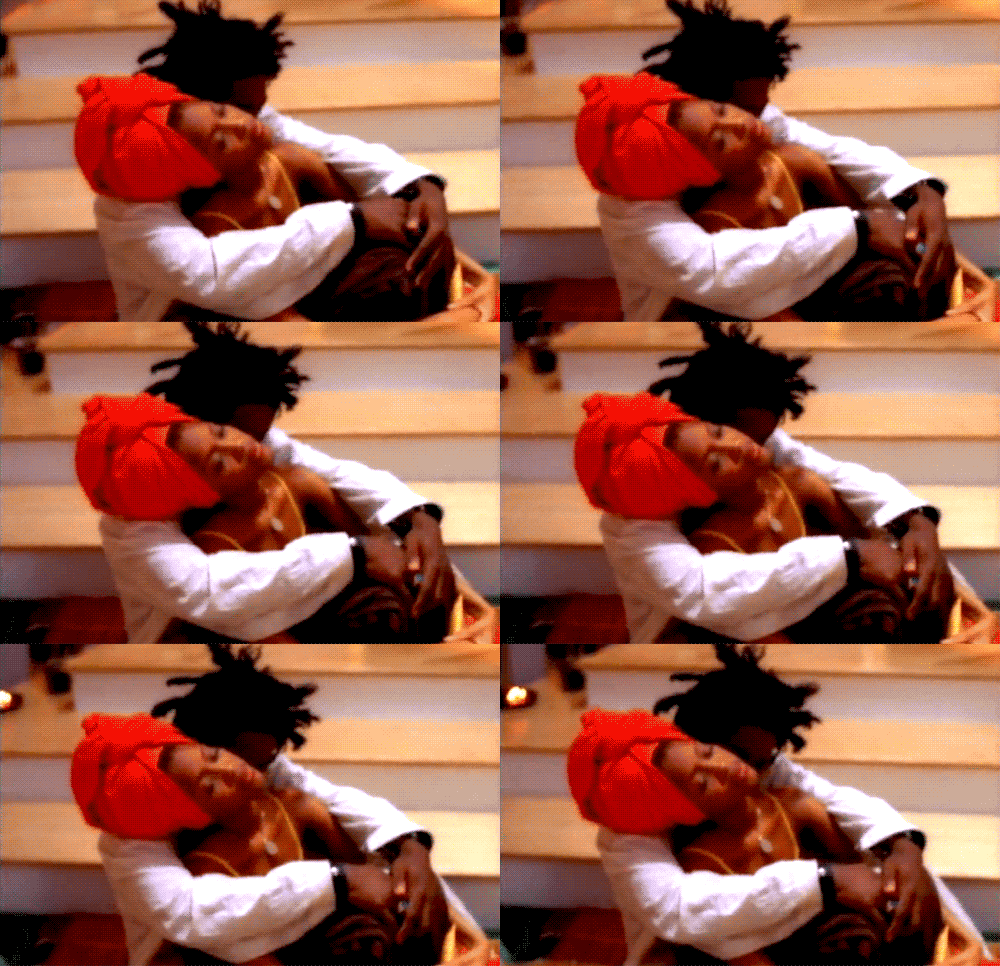
If I had to decide, to me it looks like Erykah Badu and Andre 3000 in her 1997 song “Otherside of the Game”. Erykah describes the commitment and love she has for her Black man and the things she goes through as the girlfriend of a drug dealer. In the video, you see a pregnant Erykah and a busy Andre 3000 co-existing in their loft starting their day. Importantly, this song provides an iconic soundtrack to what they are experiencing that morning along with showcasing their love as she wakes Andre up, they play fight, he caresses her belly and holds her tight as they embrace. This video provides an everydayness of waking up together and loving each other where others who watch the video can resonate with.

I also think in Joe’s video, “All The Things Your Man Wont Do”, there is sex appeal and curiosity between him and his lover.  In the beginning, you see Joe confessing his love to a woman on a pay phone and telling her that she deserves better.

This inevitably leads him to make an appearance at her job where he continues to serenade her and convince this Black woman that he possesses qualities that her current boyfriend does not. Throughout the video, the director creates a late-night mood and intimacy that is shared between the two. This is seen in the way the young woman flirts with Joe in the restaurant and making the ultimate sacrifice to take a chance with a better man

How far will Black love go?

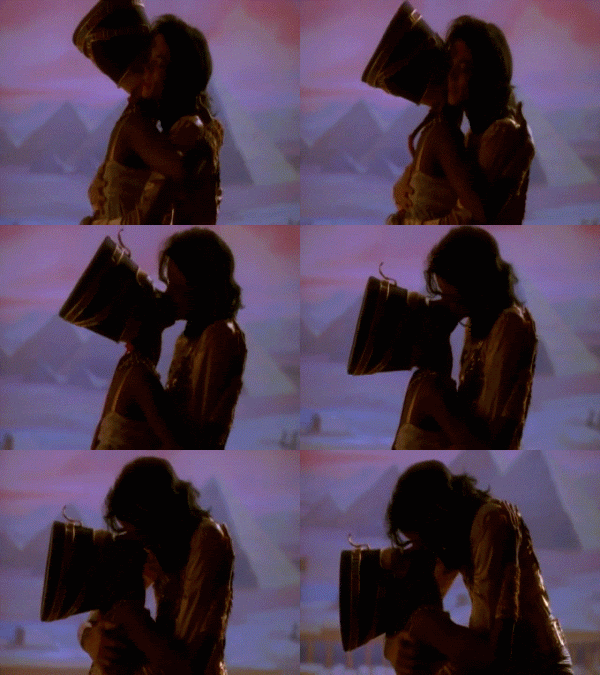
A classic R&B music video that had a more scandalous storyline, but still had meaningful lyrics was Michael Jackson’s “Remember the Time”. Boyz n the Hood director John Singleton, directed his first music video which was set in ancient Egypt and starred Eddie Murphy and supermodel Iman. Although Michael Jackson also serenaded someone else’s wife in the video, this video honored  Black people as rulers of ancient Egypt, the fight for love and an amazing dance sequence with both Black men and women of all shades. This video, in particular, reflects on the past of two lovers while still honoring the beauty of Black love and Blackness through the wardrobe selection and various skin tones of Black characters and dancers.

While many 90s artists brought us sexy and intimate love ballads, their music videos accompanied imagery that made you believe in Black love that was complicated, honest and sincere. While the videos discussed aren’t true to every relationship, these videos did portray a side of Black love and intimacy that wasn’t easily found in the typical raunchy Hip-Hop videos. R&B music videos were able to tastefully showcase all shades of Blackness that wasn’t necessarily misogynistic or overly provocative. However, it did showcase a variation of Black love and intimacy that took place in ordinary locations such as the subway, club or local coffee shop. A brotha would proclaim his love in the rain, or on the phone. A sistah would make a late night trip to her man’s crib or wake him up and sing to him in the early morning. Either way, watching and reminiscing on 90s R&B I’m sure one could find the perfect video that embodies and reflects how they feel about their Black love. — Adeerya J.


“Do the Bankhead Bounce”: Classic Cookout Dances of the 90s

When I think about my summers in Atlanta, I think about going to various cookouts my parents used to take me and my sister to when we were younger. They were either their close friends or co-workers who always welcomed my family with great BBQ, fun games and plenty of music and dancing. It’s amazing that Black people possess the creativity and dancing skills that shape dance culture in the Hip-Hop world. Some of my favorite dances came from the 90s, especially memories of having booty shaking (aka twerking) battles with my friends at summer camp and trying to do the Tootsee Roll on roller skates.

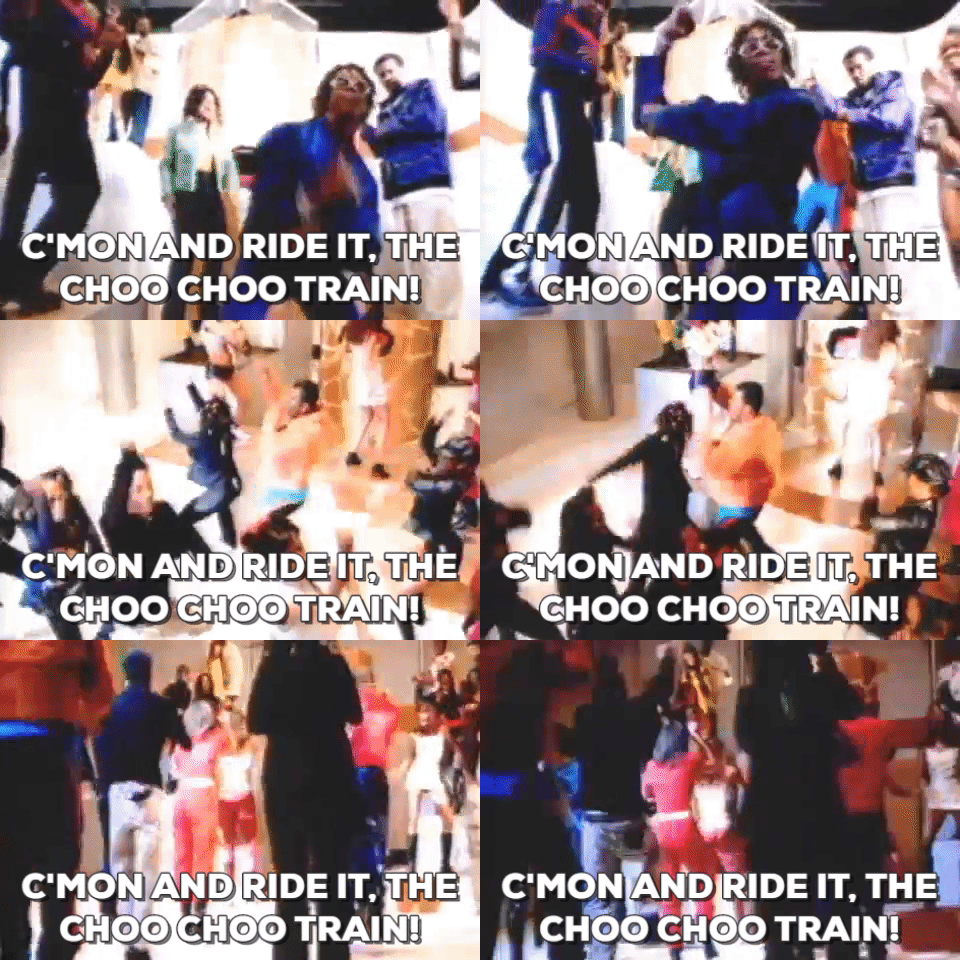
I’ve always had a love for dancing, so when my favorite song, “C’mon N’ Ride It” by the Quad City DJ’s came on at the cookouts I was ready to show out. I would begin to bounce my shoulders, roll my arms and rock side-to-side in a rhythmic fashion and proceed to ride the train. This dance was closely similar to the popular Southwest Atlanta dance, the Bankhead Bounce originating in the Bankhead neighborhood. The original song that the Bankhead Bonce originated from was performed by an Atlanta rapper named Diamond and featured D-Roc in 1996 [i]. This dance required a rapid shoulder bounce with hands and fist bouncing in front of you from side to side. This dance could have been performed to any southern Hip-Hop song such as A-Town Players, “Wassup Wassup”, 95 South’s “Whoot! There It Is” and TLC’s Waterfalls, which they performed in their music video in 1995 [ii].

Most of my early summers were spent at my local Boys and Girls Club. I had a cool group of girlfriends who were always down to dance. So, when one of the camp counselors brought in their mix city with the latest Hip-Hop songs we would rush to the boom box and dance till our moms came to pick us up. A classic was the 69 Boyz, “Tootsee Roll” which actually peaked at the number one spot on the Billboard Hot 100 Rap chart and number eight on the Billboard Hot 100 in 1994 [iii]. This dance was a more inverted funky chicken, which one would wind their knees inward while doing a dip. We also enjoyed the butterfly—similar to the Tootsee Roll, Da Dip by Freak Nasty and any other song that provided us instructions to shake our hips or drop it low.

As a young Black girl, I wasn’t aware of why I was shaking my butt at the young age of eight but similar to the women who were getting’ down at Freaknik or Black Bike Week it was a fun dance to do and you couldn’t resist the beat of the music. Growing up in the era of 2 Live Crew and Uncle Luke, or hearing songs that tell you to “Back that azz up” it’s a dance move that’s hard to refuse. When me and my friends or cousins got together at a family cookout hearing Juvenile’s “Back That Azz Up” really took over for the ’99 and the ’00. With its sexually explicit lyrics demanding listeners to back their ass up on the rapper himself, this song defiantly is a cultural favorite and can still be heard on your local HBCU campus and neighborhood cookouts.

The beauty about Hip-Hop is that it has the ability to make listeners feel good and bring people together to have a good time. I have many great memories as I reflect on the times when I used to dance to these songs. Now that I’m older the songs and the dances are quite nostalgic and take me to a place where I remember eating saucy ribs and burgers, smelling hot links on the grill, and bouncy houses in the backyard. Importantly, these dances are still remembered today and when played at parties or clubs now, me and my girls will still get low and do the Tootsee Roll and twerk to Uncle Luke’s “Cap D Comin’”. I just hope that this new generation of Hip-Hop dances continues to provide the same nostalgic memories and blissful feelings that we all grew up with in the 90s. —Adeerya J.

Citations

[i]https://en.wikipedia.org/wiki/Bankhead_Bounce

[ii] https://en.wikipedia.org/wiki/95_South

[iii]https://en.wikipedia.org/wiki/Tootsee_Roll


The Black Atlantic and Its Impact: Bringing Hybridity to Black Studies

Image source: Goodreads


I want to develop the suggestion that cultural historians could take the Atlantic as one single, complex unit of analysis in their discussions of the modern world and use it to produce an explicitly transnational and intercultural perspective – Paul Gilroy, The Black Atlantic (1993)


Since publication, The Black Atlantic has left a major impression on scholars of African American Studies, cultural studies, southern studies, and countless transnational academic disciplines.

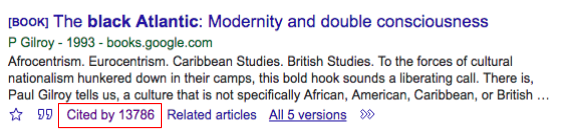
Especially in academic circles, it can be argued that the book has accomplished more than it set out to achieve in regards to inspiring cultural historians to take “the Atlantic as one single, complex unit of analysis,” as it has set people on the path to “use it to produce an explicitly transnational and intercultural perspective.” (15) In fact, many scholars and activists have cited The Black Atlantic in their explicit undertaking of transnational projects and intercultural perspectives that Gilroy outlines in the book. According to Google Scholar’s database, the book was cited over 1,200 times between 1993 and 2000. In the intervening years it has been cited over 13,700 times, at least at time of writing in April 2018.


Source: Google Scholar entry for Gilroy’s 1993 book with number of citations highlighted in red


Needless to say, it’s had (and continues to have) an impact on the academic community

But the question remains: what impact has the book that defined a region, a methodology, and a generation of scholars in the 1990s and early 2000s, had on interests around the world? 

I offer a two-part answer here, but my conclusion is essentially that The Black Atlantic put the concept of hybridity on the map for Black Studies in a big way, which, despite being situated as a re-iteration of W.E.B Du Bois’s “double consciousness” within the older frame of “modernity,” advanced a new framework for black multi-consciousness or hybridity.

The Black Atlantic has definitely helped move scholarly interest from the national frame to the transnational frame.

Data source: Google Trends

While the line graph above shows that search interest (as measured by Google queries) in the term “transnationalism” and the topic “The Black Atlantic” have declined slightly since 2004—considering the current administration at time of writing, this is not surprising—it also shows that there is a relationship between the terms. As search interest has declined in “transnationalism,” so has search interest declined in “The Black Atlantic.”

This suggests that interest in Gilroy’s book, The Black Atlantic, is linked to interest in transnationalism, which should come as no surprise to those who’ve read The Black Atlantic. Its mission is intimately tied to the postcolonial theories and missions of  scholars such as Homi K. Bhabha, who were living and writing what would eventually become the transnational turn in cultural studies of the 1990s.

Indeed, early in The Black Atlantic, we see Gilroy explaining and taking this turn away from a traditionally Anglophonic focus on national literatures:


Any satisfaction to be experienced from the recent spectacular growth of cultural studies as an academic project should not obscure its conspicuous problems with ethnocentrism and nationalism […] The question of whose cultures are being studied is therefore an important one, as is the issue of where the instruments which will make that study possible are going to come from. In these circumstances it is hard not to wonder how much of the recent international enthusiasm for cultural studies is generated by its profound associations with England and Englishness (5).


This quote is situated in a section that appears directly after Gilroy outlines the scope, problem, focus, subject, concepts, methods, intervention(s), and organization of The Black Atlantic (2-4). In discussing his organization at the end of this rundown, he writes “The final section [of the book] explores the specific counterculture to modernity produced by black intellectuals…It initiates a polemic which runs through the rest of the book against the ethnic absolutism that currently dominates black political culture” (5) This positions the book as a public address against (and undressing of) ethnic nationalism (among many, many other things).

Not long after the publication of The Black Atlantic, Gilroy brought this polemic to a mainstream audience when he went public on British television’s Channel 4 network and introduced D.W. Griffiths The Birth of a Nation (1915) as “a film which supports and affirms white supremacy” as well as “initiates a kind of taboo around intimacy between black and whites, which is still a living and central part of the Hollywood myth.”


Indeed, in this introduction to both film’s content as white supremacist propaganda, its form as a technolgical cinematic accomplishment, and its continuing legacy today, Gilroy recommends that cognitive dissonance is necessary in order to fully comprehend the film’s impact on the history of the United States and cinema. That is to say, the skepticism that Gilroy imparts to his televisual audience enacts The Black Atlantic‘s polemic against ethnic absolutism.

In a way this cognitive dissonance—or the ability to hold two opposing ideas in one’s mind at the same time—also enacts the concept of double consciousness that Gilroy uses to help frame The Black Atlantic, a concept which the book inevitably transcends with its discussion of black diaspora and the hybridity it introduced to black identity.

This brings us to The Black Atlantic‘s other main contribution.

The Black Atlantic helped redefine and resituate black identity as a hybrid identity that should be centered rather than an exclusively American, African, or African American identity formation that is marginalized.


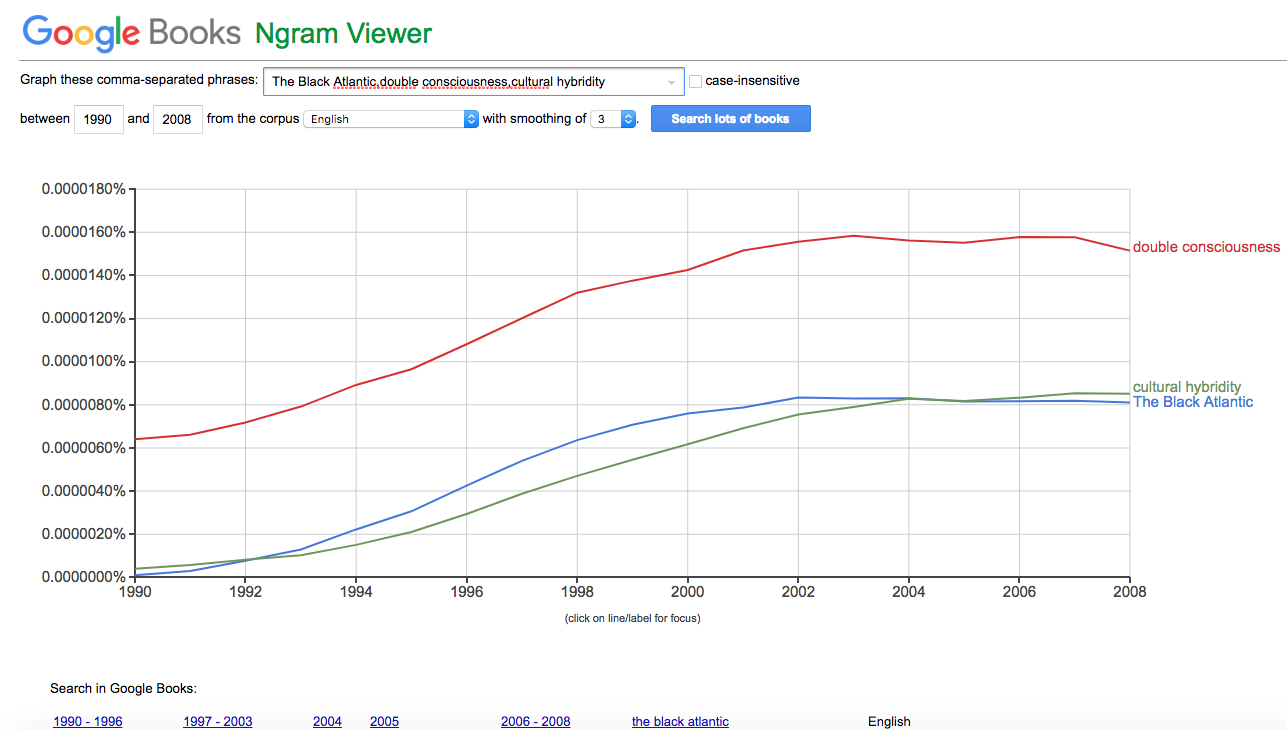
Data Source: Google Ngrams


The word frequency graph above shows us that the words “The Black Atlantic,” “double consciousness” and “cultural hybridity” show a correlation in their appearance in books between the years of 1990 and 2008. Just looking at Gilroy’s title, The Black Atlantic: Modernity and Double Consciousness, most people would not be surprised to see the relationship between word frequencies of “double consciousness” and “The Black Atlantic.” Unless they’re specialists, however, they might not expect to see that the words “cultural hybridity” appear on the proverbial map with around the same word frequency (and emerge at about the same time) as the words “The Black Atlantic.”

What this suggests is that while The Black Atlantic makes use of W.E.B Du Bois’s “double consciousness,” it’s true contribution to conversations revolving around Du Bois’s concept—the one for which it is most closely associate per Google Ngrams and in much of the scholarship that uses it—was advancing a new framework for “cultural hybridity,” or something more akin to black multi-consciousness (rather than double consciousness).

We can start to see why Gilroy advocates for a more culturally hybrid model of black identity for The Black Atlantic when he advocates for moving and  re-centering the historical compass of modernity not in Western Europe, but in the Black Atlantic and its plantation slave economy. And this is arguably the largest crux of his book:


Plantation slavery was more than just a system of labor and a distinct mode of racial domination. Whether it encapsulates the inner essence of capitalism or was a vestigial, essentially precapitalist element in a dependent relationship to capitalism proper, it provided the foundations for a distinctive network of economic, social and political relations. Above all…it has retained a central place in the historical memories of the black Atlantic (55).


Here, we’re reminded of how Gilroy characterizes plantation slavery in Chapter 1:  “capitalism with its clothes off” (15). This quote builds on that sentiment, but more importantly, it centers plantation slavery as the defining topos and locus of history and memory in the Black Atlantic world. Gilroy uses this argument to build a case for centering plantation slavery as the organizing principle that defined not only the the modern political and socioeconomic world, but the entire cultural framework upon which the concept of modernity was founded.

Staking this claim for the importance of a multiplicity of black perspectives, which emanate and spread from modernity’s cultural center rather than margin, Gilroy concludes, “The time has come for the primal history of modernity to be reconstructed from the slaves’ points of view” (55).

In all of these ways, and many more, The Black Atlantic brought hybridity to Black Studies and shaped the direction that the discipline would take towards a more enriched perspective on blackness that would be able to discuss multiplicities of black identity rather than simply doubleness.

Thinking to the Future

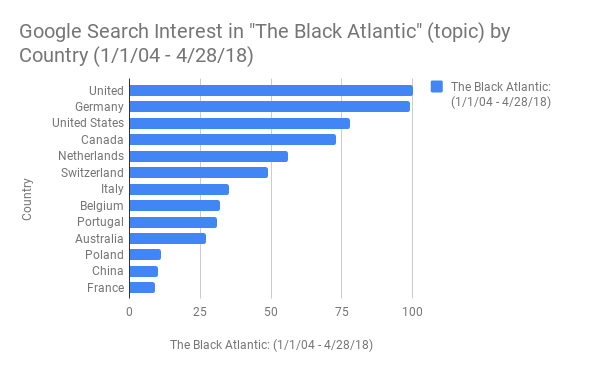
As the bar graph below illustrates, however, much work may remain to be done to bring The Black Atlantic‘s discussion of black hybridity to more global locations than Western Europe.

Data Source: Google Trends


It is interesting that most of the nations where Google search interest is highest in The Black Atlantic are former colonist nations, whose populations are predominantly white. Should we be thinking about bringing Black Atlantic to more global audiences, such as Africa, in ways that don’t replicate colonial intellectual thought patterns? How might we do that?

— Joshua Ryan Jackson

Work Cited

Gilroy, Paul. The Black Atlantic: Modernity and Double Consciousness. Harvard UP, 1993.

Sister, Sister: Sisterhood & Womanism in the 90s

Womanism: “Also: A woman who loves other women, sexually and/or nonsexually. Appreciates and prefers women’s culture, women’s emotional flexibility (values tears as natural counterbalance of laughter), and women’s strength. Sometimes loves individual men, sexually and/or nonsexually. Committed to survival and wholeness of entire people, male and female. Not a separatist, except periodically, for health.”[1]

Alice Walker     

A close friend told me being a Black woman is like being in a secret club of magic, sisterhood and friendship. Reflecting on Black women’s friendship and sisterhood on television and movies in the 90s, I, similarly see a consistent theme of support, unconditional love and acceptance.  These themes can be aligned to how Alice Walker describes a Black feminist in her definition of Womanism. Walker describes Womanism as young girl as “girlish” or  “womanish” or a black feminist or feminist of color. I find her description of Womanism as a means to provide a specific exploration into the lives of Black womanhood.

 I look specifically to Walker’s second definition because it captures the essence of the 90s Black woman who aims to take on the responsibility to be in charge of herself and to question the world around her. I reference how this can be explored in the hit show Living Single and the hit movie and book Waiting to Exhale. I utilize Walker’s second definition to explore how these women embody the spirit of being a womanist through the ways their characters interact with each other and how they stand alone as independent Black women loving and living in the 90s.

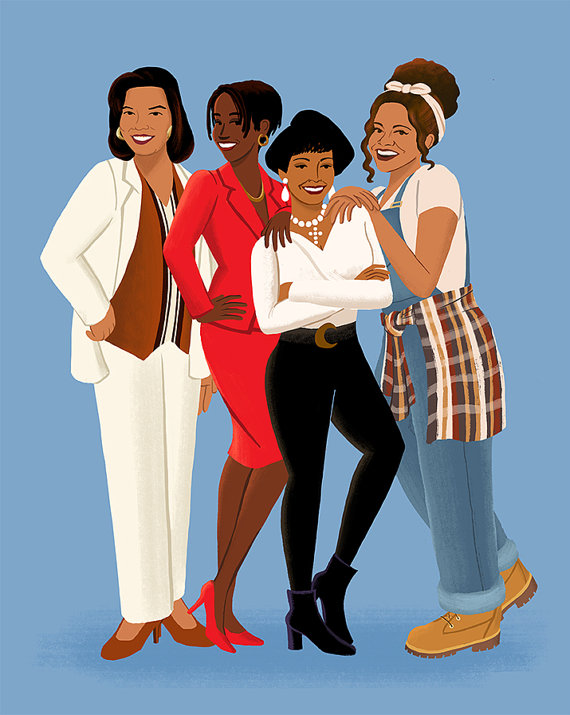
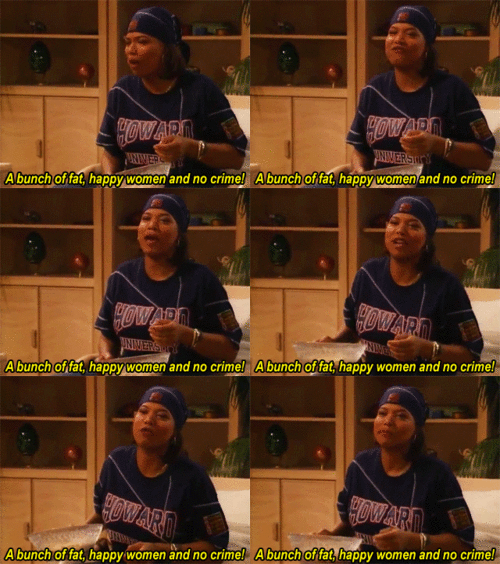
Looking at the lives of Khadijah James, Synclaire James, Regina Hunter and Maxine Shaw, Living Single explores the lives of four independent Black women in New York City. This show captures the “everydayness” of single Black women in New York who validated each other, dealt with love and relationships and enjoying each other’s company.

With each woman having their own characteristics and identities, each woman on the show had an important role in each other’s lives. Khadijah and Regina were childhood friends who supported each other when things got tough. This support and commitment were also fluid in Khadijah and Synclaire’s relationship as cousins who she employed at her own Hip-Hop magazine called “Flava”.

Maxie and Khadijah were college friends from Howard University and Maxie seemed to always be the advocate for strong independent Black women amongst her friends. Their friendship supports Walker’s definition because of the characters emotional flexibility, their commitment to women’s empowerment and their tough bond as friends that were seamlessly interconnected, through the best and worst of times.

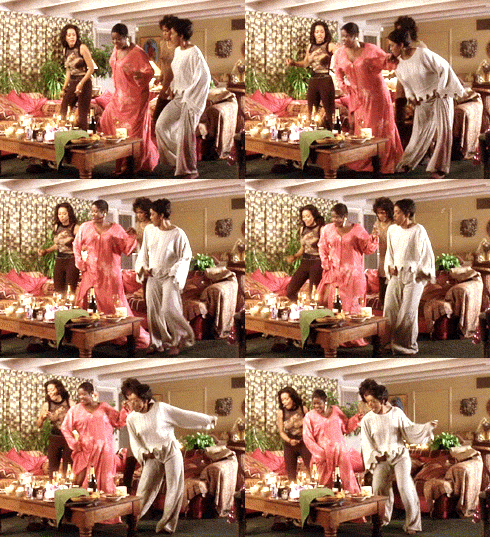
Walker does a great job discussing the emotional and spiritual effort that goes into being a Womanist. Walker explains how Womanist appreciates women’s culture, loves women sexually and non-sexually and values a woman’s strength and weaknesses[2]. This is where the women in Terry McMillian’s Waiting to Exhale fit this definition. Savannah Jackson, Bernadine Harris, Robin Stokes and Gloria Matthews experienced tough trials of love, life and men. Through their experiences, the women supported each other through it all. There were words of affirmation and emotional support that showed people like Bernadine who was going through a terrible divorce that her friends were by her side.

I see Walker’s womanism as describing the social interactions, spiritual activism and critical thought that Black women do to uplift all people regardless of sexuality or gender. I understand this definition as a way to look at Black women’s liberation and healing of the self. Specifically, acting “womanish” seems to be a central theme in Waiting to Exhale. The four women were searching for answers to love, family and womanhood which is where I found the connection with Walker’s definition. This can be seen in Robin’s way of how she seemed to date the wrong men, but tried to see the best in them because she had love to give. Walker added the importance that a Womanist was not a separatist, but only in the occasion that Black woman in the 90s needs to repair her health. Gloria symbolizes the friend who represented self-care as a hairstylist and made sure her friends were always taking care of themselves, even if she didn’t want to do the big chop on Bernadine.

Furthermore, the importance of Walker’s definition and the analysis of  Black woman’s thoughts and feelings will better aid to the mental and emotional health and well-being where the Black woman can adequately take care of others and themselves in shows like Living Single and Waiting to Exhale. The womanist identity and the importance of Black women’s “everydayness” in the 90s was significant, interesting and relevant to highlighting the ugly and the beautiful of what it means to be a Black woman. These women work on coming into their own and being Black adult women who may not have it all figured out. But with the power of resilience, self-love and love for each other, the magnitude and power of their friendship kept them moving forward. — Adeerya J.

Citations

[1]Walker, A. (2006). Womanist. In L. Phillips, The Womanist Reader (p. 19). New York: Routledge.

[2]ibid.


The Real World Prototype and Reality TV

The Real World Logo

As a network developed to provide a new platform for music’s developing stars, MTV changed the lives of countless young artists looking for a break into the industry. During the 90s, MTV featured shows that primarily emphasized music: Yo! MTV Raps, MTV Unplugged, Alternative Nation, Club MTV, and Total Request Live are several programs that linked the entertainers and fans together by giving the fans control over what content aired. MTV’s popularity anchored itself in the young viewership of teens and young adults between the ages of 18-25; the pride of the network centered around creating a space dedicated to youth popular culture and the decade’s hottest rappers, rockers, and pop stars.

MTV also designed programming that focused on broader topics, like MTV News, in an effort to round out its offerings. The network’s longest running series, MTV’s The Real World, highlighted the day-to-day lives of young people from various backgrounds living together in a predetermined city. The show’s introductory tagline became ubiquitous with its content, and viewers could always count on an explosive combination of personalities to fuel each season’s unpredictable episodes:

“This is the true story of seven strangers, picked to live in a house, work together, and have their lives taped. Find out what happens when people stop being polite and start getting real…”

For twenty-five years, young people from different geographic locations and with varying backgrounds came together in cities throughout the country for our viewing pleasure, making The Real World the first successful reality television show broadcasted in America.

The Real World was modeled after Beverly Hills 90210 and Melrose Place, as an alternative to major network soap operas targeting middle-aged women. Mary-Ellis Bunim and Jonathan Murray, the show’s creators, opted for the “reality” format of The Real World, because their budget didn’t allow for writers, set design, actors, etc. So, they decided to let the participants create the storyline. The show’s first season was set in New York City and filmed over a three-month period, with each cast member receiving $2,600 for appearing on the show. And in New York, things got really real (well, at least according to mainstream TV content in the 90s).

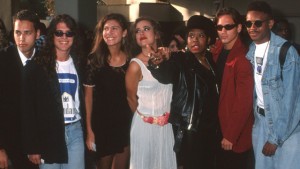
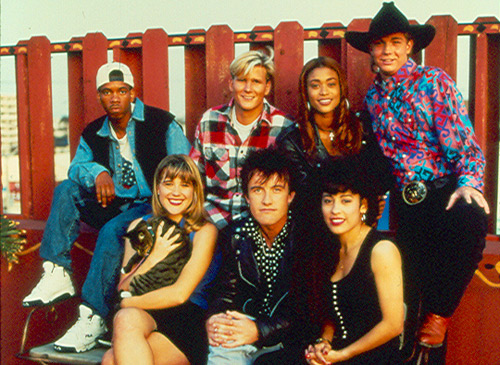
What later becomes typical behavior amongst The Real World castmates was exciting and fresh during its 1992 debut (and for a few seasons thereafter). The thirteen episodes of Season One show Becky, Kevin, Heather, Julie, Andre, Eric and Norman working through romance, sex, illness, familial relationships, and social issues. The roommates are divided by gender 3:4 (female-to-male), and 5:2 ethnically (with two African-American cast members). Race plays a factor is several episodes, with Kevin Powell leading many conversations that highlight divisions within the house. His (in)famous confrontation with roommate Julie Gentry demonstrates the organic manner in which controversy arose, making the episodes worth watching.

Norman Korpi, Andre Comeau, Julie Oliver, Rebecca Blasband, Heather B., Eric Nies and Kevin Powell of The Real World New York Cast (Photo by Ron Galella, Ltd./WireImage)

The abridged version of the confrontation goes as follows: Julie accused Kevin of threatening her with physical violence and spitting at her after she refused to let him use their house phone (remember: this show’s original airing predates cell phones and all things technologically mobile). He admitted to being upset with her but denied spitting at her. When Norman and Eric sided with Julie, Kevin pointed to race as the underpinning for Norman and Eric’s alignment with Julie, but Julie sited what she determined as Kevin’s past record of aggressive behavior as the justification for her sentiments. The parties later reached some type of amicable resolution, but this episode created a precedent later followed by other seasons, where not only race, but religion, gender, and sexual orientation often divided the castmates. The show’s best moments are those credited for opening up tough conversations among young people.

Future roommates, almost always from various upbringings and of different ethic backgrounds, would confront similar issues: race, gender discrimination, differences concerning sexual orientation, political beliefs, body image issues, and religion. In Season Two, The Real World: Los Angeles, castmates Tami Akbar (m. Roman, later star of VH1’s Basketball Wives) and David Edwards divide the house after what begins as a prank targeting Tami. The incident escalated to a physical confrontation between the cast members, ultimately resulting in the decision to remove David from the house.

The Real World may be credited as the pioneering reality television program, and its influence remains evident in various popular “reality” TV shows on various networks. While there’s a show out there for a number of interests—meant quite literally, as every network, from HGTV to The History Channel, offers some reality-based series— few strike more intrigue than those offering insight into Black culture. More specifically, many shows feature African-American women feigning friendships, chasing men, and digging into entrepreneurial endeavors. And no Black reality TV show is complete until an episode features a shade-throwing-, tea-spilling-, let-me-get-you-together-type confrontation. The entertainment factor is undeniable, though, as shows like Bravo’s The Real Housewives of Atlanta and VH1’s Love & Hip Hop have reached ratings as high as 4.3 and 3.8 million, respectively.

Bunim and Murray’s reality TV formula allowed for an organic plot-development (although film was edited to help establish a traceable storyline), and the issues the casts encountered mimicked situations relatable to the audience. As The Real World progressed, audiences criticized producers for what many perceived as scripted conflicts and contrived conversations. It seems, however, that recent reality TV shows are only popular if the drama is “too good to be true.”

Nonetheless, our favorite reality starlets are also feeling a little shade from their fanbases, too. Ratings for many shows reflect a decline in viewership over the years, and in an effort to remain relevant, many storylines have expanded far too far away from “reality” (Do they have to fight every week?). And more troubling, for some, is what’s frequently cited as a collective misrepresentation of Black woman and the threat of conveying a distasteful, inaccurate message to young Black girls about Black womanhood in America.

Because of a history of oppression, subservience, dispossession of the body, abuse, malicious sexual intrigue, and marginalization by American at-large, we may question if Black reality TV supports or disrupts the perpetual race- and gender-based pursuit of acknowledgement, acceptance, and encouragement of Black women (and other women of color) in society. Are these women our entertainers, role models, or stereotype perpetuators? —Shari Arnold


RHOA

LHHA Cast

References

<http://www.emmytvlegends.org/interviews/shows/real-world-the>

<http://www.usmagazine.com/entertainment/news/real-world-new-york-cast-reuniting-22-years-later-on-oprahs-show-20141712>

<https://lmarsh11.wordpress.com/tag/seven-strangers-picked-to-live-in-a-house/>

<http://www.theroot.com/articles/culture/2013/03/race_on_the_real_world_retro_mtv_and_social_issues.2.html>

<http://www.ibtimes.com/mtv-ratings-decline-raises-relevance-questions-young-people-cut-cable-cord-devices-1881468>

<http://allthingsrh.com/rhoa-ratings/>

<http://allhiphop.com/2015/05/08/is-love-hip-hop-languishing-in-ratings/>

R and B Takes Over: The Evolution of Rhythm and Blues through the 90s

ilovethe90s

Every decade has its musical era or movement with which it is equated, and the 90s was no different. From doo-wop and Motown owning the 60s, disco reigning in the 70s, to the dawn of hip hop in the 80s, they all contributed to a new genre and culture of music that would come to be known as rhythm and blues (r&b).  The mixture of soul, blues, rock and roll, and disco, and ultimately hip hop shaped r&b as it allowed artists to take different musical avenues and/or combined the sounds to create something new for the next generation.  The 1990s introduced another wave of girl and guy groups that skyrocketed to fame by including “ elements of rap—including sampling, scratching (a percussion technique that involves running a record needle manually across vinyl records), and declaimed vocals—had become part of what could perhaps best be described as dance-based, post-disco music” (The History of R&B).

silk

Jodeci1

BBD-Promo-2

The likes of Jodeci, Silk, Boyz II Men, BellBivDeVoe, Dru Hill, Next, and Mint Condition produced a range of songs from party music to baby makers to “baby, please don’t leave me’s”.  These guy groups exhibited soulful sounds and sex appeal that made their audiences swoon.  The stacked harmonies made for musical delight, and the half-naked wardrobe was aesthetically pleasing.  Songs like Jodeci’s “Forever My Lady” and “Do You Believe In Love” displayed how they were proud to exclaim love and adoration for women, and Dru Hill’s “We’re Not Making Love” that showed heartache at the hands of a failing relationship.  However, don’t sleep on the ladies, groups like SWV, TLC, Xscape, Brownstone, and Destiny Child had a following that would make Greek gods jealous.  Varying in looks from baggy and oversized to fitted and seductive clothing, girl groups of the 1990s also had something to say about life and love. SWV told us that the love of the right man can make you “Weak” in the knees, and that sometimes women are willing to do whatever it takes to find out if “[He’s] The One”.  Xscape helped us find someone “to run to when [we] need love”, and also gave us permission to keep a “Little Secret” but only if he’s worth it. 90s r&b music was so emotionally charged ranging from happy in love to brokenhearted to just getting down to the nitty gritty.

SWV xscape-e1341933895975While groups reigned supreme, no one knew how to get down better than Mr. Bump and Grind himself, R. Kelly.  The Chicago native ruled the 90s with his seductive slow jams to get you in the mood.  With his sexually suggestive lyrics, and powerful tenor/baritone voice, R. Kelly knew how to reach his audience.  The ladies loved him with his tall, solid stature and bald head, and the fellas either wanted to be him or beat him for upping the ante of sex appeal and female appreciation.  He was just one of many that made women go crazy for their looks and voices, some of his musical peers include: Eric Benet, D’Angelo, Ginuwine, and Maxwell.

r kelly

The 90s also brought about quite a few female heavy-hitters such Mary J. Blige (who would come to be crowned the Queen of Hip Hop and R&B), Faith Evans, Janet Jackson, Erykah Badu, and Lauryn Hill.  Given such the diversified artistry of these women, they were at the top of the r&b charts through their own respectful channels, occasionally joining forces to blow our minds.

mary-j-blige-k-ci

Mary J. Blige hit the scene in a major way in 1992 with her debut album “What’s the 411?” This album featured her first single “Real Love” (Bowser).  The soulful raspy-ness, pain, and “street” influence of her voice made her relatable to the everyday woman.  She spoke about love in a real, raw, and uncut way, all of its ups and downs, goods and bads.  In the interim of her developing success she began dating lead singer of Jodeci “K-Ci”.  Their love was one of epic proportions, but “crashed and burned” after many years of tumultuous events.  There is no doubt that the love was real, K-Ci said so himself- ‘“I was in love with Mary. She never did anything wrong to me. She always gave me my props.”’ But they were self-destructive together and toxic for one another as both struggled with substance abuse. Though it made for good music, both were on a downward spiral until the hit rock bottom, but the love they shared will always be unmatched. —Nikkia Grant


Works Cited

Bowser, Edward. The Kings and Queens of R&B :1990-1999. 18 May 2015. Web. 13 December 2015. <http://www.soulinstereo.com/2015/05/the-kings-and-queens-of-rb-1990-1999.html>.

Hailey, KCi. K-CI OPENS UP ABOUT TUMULTUOUS RELATIONSHIP WITH MARY J. BLIGE: “I’M NOT GON’ LIE, I DID SOME THINGS” The Breakfast Club. Ed. Jazmine Denise Rogers. 2 April 2015. Web. 13 December 2015. <http://madamenoire.com/523153/k-ci-opens-up-about-tumultuous-relationship-with-mary-j-blige-im-not-gon-lie-i-did-some-things/>.

The History of R&B. n.d. Web. 13 December 2015. <http://slambeck.home.xs4all.nl/His/slshis4.htm#_Toc478089277>.


Nelson Mandela Comes to Harlem

Nelson Mandela was an anti-apartheid civil rights leader that was born on July 18, 1918 in Mvezo, Transkei, South Africa.  As a young man he became very involved in the anti-apartheid movement according in South Africa.  This movement was very much synonymous to that of the Civil Rights Movement of the 1960s in America.  Mandela fought for equal rights and privileges of black South Africans that had been taken at the hand of the predominantly white government.

Mandela was imprisoned in 1963 and remained there until his release in 1990.  He then went on to lead South Africa until 1994.  On June 21, 1990 Nelson Mandela traveled to Harlem in New York City to deliver a message.  His presence ignited hope in a community that was seemingly deteriorating and desperately needed a savior.  People gathered in anticipation of what the world leader had to say.  The New York Times quoted a mother named Mrs. Valladares as saying, ‘“Nelson Mandela will actually be in Harlem… He reminds me of Martin Luther King… He fought for his people. And he’s not going to give up now. He’s a survivor, just like I am.”’  New York natives waited for hours just for a glimpse of Mr. Mandela.  This significant moment is definitely one that stands for me because this happened to be the day that I was born in Harlem, NY.  It ties me to history.  Mr. Mandela was one to be admired and revered for his efforts in the anti-apartheid movement, and his presence in my hometown as I made my way into the world always keeps me tied to this historical moment. —Nikkia Grant


Works Cited

McCray, Melvin. “Nelson Mandela Visits Riverside Church Harlem, New York.” Vimeo. 21 June 1990. Web. 1 December 2015. <https://vimeo.com/82911147>

Nelson Mandela Foundation. “Biography of Nelson Mandela.” Nelson Mandela Foundation. 2015. Web. 1 December 2015. < https://www.nelsonmandela.org/content/page/biography>

Terry, Don. “The Mandela Visit; In Harlem, a Name to Add to Martin and Malcolm.”The New York Times. 22 June 1990. Web. 30 November 2015. <http://www.nytimes.com/1990/06/22/nyregion/the-mandela-visit-in-harlem-a-name-to-add-to-martin-and-malcolm.html?_r=0>


Female Rap Royalty of the 90s

With the increased popularity of hip hop culture in the 1980s, it was only right that women took their rightful places at this musical table. Many female emcees, or rappers as they would come to be known, saw the 1990s as their opportunity at stardom. They felt that their messages were just as important as those of their male counterparts. From the legendary MC Lyte who rocked the late 80s into the early 90s to Ms. Lauryn Hill whose sultry voice bridged hip hop and r and b, female emcees of the 1990s were a force to be reckoned with. They enlightened the world about important issues such as the respect of women, female equality, sexism, and social injustices in the “hood”, while simultaneously displaying sensuality and sex appeal.

mc lyte

The dawn of the 90s broke with artists like Queen Latifah, YoYo, and Lady of Rage. They spoke out about how women should be treated, and the respect that they deserve as part of society and the rapidly growing hip hop genre. Latifah’s hit record “U.N.I.T.Y.” addressed sexism with lyrics like, ” I had my cutoff shorts on right cause it was crazy hot/ I walked past these dudes when they passed me/ One of ’em felt my booty, he was nasty/ I turned around red, somebody was catching the wrath/ Then the little one said (Yeah me b****) and laughed/ Since he was with his boys he tried to break fly/ Huh, I punched him dead in his eye and said “Who you calling a b****?”‘ (Genius). Lady of Rage let the world know that she ran things and wasn’t a punk or scared rather “[she] rock[s] rough and stuff with [her] Afro Puffs/ (Rage)/ Rock on, wit’ cha bad self.”

yoyoqueen latifah lady of rage


Although many of the first female emcees hailed from the northeast of the United States, in 1994 a young woman who would come to be known as Da Brat released her debut album that sold over a million copies making her the first female hip hop artist to go platinum (March). The mid-90s ushered in a much more liberated, coarse, raw era. The likes of Foxy Brown and Lil Kim opened the doorway for female hip hop artists to be as sexually and verbally explicit as their male counterparts. They addressed “street life” from the female perspective. From the hood beat of Kim’s chart toppers to the island vibe of Foxy’s club bangers, these female emcees publicly gave women permission to live life adulterated and unapologetically uncut as they spit lyrics only previously heard by men and dressed in a manner which left little to the imagination.

da brat

lil kim        foxy brown


As the new millennium approached, many more artists began to rise to power. Eve: First Lady of Ruff Ryders, Missy Elliott, and Lauryn Hill diverged in different directions as they diversified the hip hop genre. The rough around the edges, Philadelphia native, and only female member of the Ruff Ryders crew immediately came in marking her musical territory. Missy Elliott hailing from Portsmouth, VA arrived on the scene with her futuristic concepts and vivid musical metaphors. Finally, none other than Ms. Lauryn Hill only female member of the group The Fugees (Refugees) that spoke to social consciousness. Her warm, embracing voice and old school hip hop vibe allowed her to bridge the gap between genres and generations. Her debut solo album “The Miseducation of Lauryn Hill” earned her five Grammy awards at the 1999 awards show. Female emcees definitely made their mark on hip hop history and paved the way for artists on the future. –Nikkia Grant

eve 2missylauryn hill

Works Cited

Genius Media Group Inc. Genius. 2012. Web. 28 November 2015.      <http://genius.com/Queen-latifah-unity-lyrics>.

March, Chase. The History of Women in Hip Hop. 6 April 2013. Web. 20 November 2015. <http://chasemarch.com/2013/04/the-history-of-women-in-hip-hop.html>.


The Murder of James Byrd, Jr.

james byrd

Forty-three years after the heinous lynching of the young African American teenager, Emmett Till, America witnessed again how racism is still extremely present in the American south and how it is the driving force of such brutality that claimed the life of James Byrd, Jr. Many were oblivious to the possibility that hate crimes, such as chaining an innocent man to the back of a truck and dragging him for miles was still a threat in the 21st century, but James Byrd, Jr.’s death proved otherwise. On June 7, 1998 in Jasper, Texas, 49-year-old James Byrd was walking home from his parent’s house when he accepted a ride from three white men, Shawn Berry, Lawrence Russell Brewer, and John King. Although Byrd and Berry were associates who knew each other from around the small town, Byrd was not acquainted with King or Brewer. James Byrd was unaware that both men were affiliated with white supremacists groups formed in prison. The three men did not end up taking Byrd home. Instead, they beat him relentlessly and chained his ankles to the back of a pickup truck. King drove the pickup truck for three miles, dragging Byrd’s body over the asphalt road. Many reports have claimed that Byrd was conscious throughout the entire ordeal, until he was decapitated. The three men drove for another mile or so before leaving Byrd’s torso in front of an African American church. After Byrd’s torso was discovered by church members the following morning, and the investigation began, it was reported that police found Byrd’s remains in 81 different places along that road.

All three men were tried and convicted for Byrd’s murder. Berry was sentenced to life in prison, while King and Brewer were given the death penalty. Brewer was killed by lethal injection on September 21, 2011. Prior to being executed, Brewer showed absolutely no remorse for his crime. “As far as any regrets, no, I have no regrets,” Brewer told KHOU 11 News in Houston. Despite the lack of remorse from Brewer, Byrd’s family members wanted to spare the lives of Brewer, King and Berry surprisingly. James Byrd’s son, Ross Byrd initially supported the death penalty for his father’s killers, until he had a change of heart, opposing all capital punishment. His decision was supported by the idea that violence cannot drive out violence. The amount family members of victims killed by hate-crimes driven by racism who oppose capital punishment has grown in recent years. One of the organizations that has been formed, Murder Victims’ Families For Reconciliation, stands on this guiding principle: “From experience, we know that revenge is not the answer. The answer lies in reducing violence, not causing more death. The answer lies in supporting those who grieve for their lost loved ones, not creating more grieving families. It is time we break the cycle of violence. To those who say society must take a life for a life, we say: ‘not in our name.’”

As a result of James Byrd’s death and the death of Matthew Shepard, another hate-crime that took place in 1998, President Obama signed the Matthew Shepard and James Byrd Jr. Hate Crimes Prevention Act in 2009. The law criminalizes violent acts (and attempts to commit violent acts undertaken with a dangerous weapon) when those acts occur because of the actual or perceived race, color, religion, or national origin of any person. —Jamari Devine

css.php