Nigga…bitch…hoe…Offensive language or terms of endearment? Boyz N the Hood, NWA, Terry McMillan, and other prominent black artists, directors, and authors in the 90s often used these terms interchangeably to refer to women and men. The use of these terms bring up one debate that continues to persist today: The words “nigga,” drop the –er and replace with an –a, “bitch/hoe” are not as offensive as they used to be. They are now words that black people can use to show camaraderie.
“Nigger” has a complex and touchy history in the United States. “Negro” evolved into “nigger” and became a racial slur white people used to refer to blacks. White people who used this word did not mean to express love for blacks, rather it was meant to degrade and dehumanize. However black people have retained the word, even altering its spelling in order to express brotherhood, which was commonly seen in hip-hop culture. The film Boyz in the Hood perfectly illustrates how the word was used. Main characters Tre, Doughboy, and Ricky do not hesitate to call each other or others “niggas” and no one is shocked, offended, or outraged by its use.
But does the glamorized use of the word diminish the emergence of black consciousness? Bruce Jacobs says in his book Black Manners: Navigating the Minefield between Black and White Americans that the use of “nigga” is an act of defiance, a way to destroy yourself before white people could. He goes on to say, “The 1980s and early 90s defiant use of nigga as self-reference by young black people captured, more than any other act, the desperate dilemma of black identity: self-hatred coupled with a stubborn resolve for self-determination. To proclaim oneself a nigga was to declare to the disapproving mainstream, ‘You can’t fire me. I quit’” (12).[i] One could surmise that a new consciousness is born out of the word’s harsh history. Reshaping the abusive term “nigger” to “nigga” serves as a way to reconcile the past and a way to create a new identity, one we’ve created instead of one that has been force fed to an entire population.
“Bitch, you crazy.” “That bitch is fine.” “That hoe didn’t call me back.” Although they are slightly less controversial than “nigga”, “bitch” and “hoe” are terms that were widely used in the 90s and today. The terms mean different things depending on how they are used. For instance, in Terry McMillan’s Waiting to Exhale, the main (female) characters refer to each other as “bitch” or “hoe” in jovial ways. On the other hand, when someone wants to disrespect another woman or even a man, both terms are used.
“Bitch” and “hoe” do not carry the same history as “nigga,” but all three serve as an example of the evolution of language. As a child my father often told me to never let anyone call me outside of my name (i.e. calling me a “bitch”) and I did not. Yet as time goes on, all three words roll off the tongue a little easier. The article “The Evolution of the Word “Bitch”: Sexist Slight or Empowering Expression?” states: The early 1990s, third wave feminism was born out of a need to address movements and activism of second wave feminism. Third wave feminism is known for its agenda including reproductive rights, social class, race, sexuality, “girl power,” “the glass ceiling” and the reclaiming of derogatory words. Words that they aimed to reclaim, that is “take back” and give new meaning to, included bitch, cunt, whore and spinster. The 90’s are looked back upon in history as a time of “girl power.” (Sassy Notations) [ii]
Whether for women, blacks, or both, taking back and renaming are common themes in the 90s. The basic premise on the use of “nigga,” “bitch,” and “hoe” were embraced to create new meanings and new consciousness.
It is safe to say that not everyone is using “nigga,” “bitch,” or “hoe” in the 90s were trying to create a new identity, and the reclaiming of these terms do not erase the sting that many people still feel when they hear them. Yet reclaiming and renaming provides some context for the emergence of the terms’ popularity. They were meant to add to black consciousness, not diminish it. However, I can’t help but wonder: does the continued use of “nigga,” “bitch,” and “hoe” today carry on the black consciousness of the 90s or do the reasons no longer add up?
A call for Atonement, Reconciliation and Responsibility
Inspired and led by the Honorable Minister Louis Farrakhan, more than a million Black men gathered in Washington, D.C. on Saturday October 16, 1995 to declare their right to justice to atone for their failure as men and to accept responsibility as the family head.
Although the DC park service estimated the numbers of Black men to be around 830,000, it was more Black men on the mall that day than there were Black men in all of America’s prisons. Black men from all walks of life, and from all parts of the nation and the world made the mass pilgrimage to Washington D.C. on that fateful Saturday, October 16, 1995.
We did not come to Washington in hopes that all of our issues would be solved in a day. We did not converge on the nations capital that day to petition the government to free the hundreds of thousands of Black men that were tried and convicted by a jury that were not their peers. We did not make this the largest peaceful gathering in history on the nations doorstep to beg for Civil Rights. We did not stand for ten or more hours at rapt attention to ask for justice for the Rodney Kings and the Nicholas Heyward Juniors of America.
We came because we were called – called to atone. In hopes of moving beyond the mere “articulation of Black injustices” The honorable Minister Louis Farrakhan and organizers of the event lifted the march from a strictly political level to a spiritual one. “The Day of Atonement” was another name of the march and it was definitely the reason that the march was called. It was a day of learning how to “become at one” with our spiritual selves and one with our Black people.
Mainstream media in American and media outlets from around the world were watching. The world did not see criminals, absentee fathers, idiots, and savages as usually portrayed through mainstream music, movies and other forms of media; on that day, the world saw Black men united in America. If only for one day every mothers son and every fathers daughter that tuned in to CNN, CSPAN, the BBC, and other forms of mass media saw a real depiction of Black men and if they listened to any of the litany of Black male speakers that spoke on the nations capital that day they heard what a real Black man sounds like.
The world saw Black men demonstrating the willingness to shoulder the responsibility of improving themselves and the community. There was neither one fight nor one arrest that day. There was no smoking or drinking. The Washington Mall, where the March was held, was left as clean as it was found. Two of the best descriptions of the Million Man March include the word “miracle” and the phrase “a glimpse of heaven.”
Jihad S. Uhuru
References
http://www.blackpast.org/aah/million-man-march-1995. http://www.noi.org/about-million-man-march/
Madhubuti, H. (1996) Million man march/day of absence: A commemorative anthology, speeches, commentary, photography, poetry, illustrations & documents. Third World Press. Chicago.
“Mention Freaknik to any native Atlantan and you’re in for an earful — while the celebrations ended years ago, the memories are still fresh in many peoples’ minds,” wrote Michael Kahn.[i] Freaknik began in the mid 80s as a small picnic between Morris Brown and Spelman students, yet really gained traction and popularity during the early to mid-90s and became an important staple in the black college spring break experience. An impromptu gathering birthed a street party that attracted HBCU students across the country and by 1993, Atlanta’s streets were packed with students looking to party and as the name suggests, get their freak on. The music was loud, the clothes were tight, the drinks were flowing, and the streets were crowded. When stripped down to these terms Freaknik represented a time for black students to get together and just chill.
Atlanta has a history of breeding and nurturing black American culture and Freaknik was no exception. Freaknik of 1993 took the city by surprise when at least 100,000 college students stormed Atlanta, making it a party zone. What made Freaknik of 1993 incredible was the power of word of mouth. No one tweeted, IGd, Facebooked, or Snapchatted the event, it just happened. Students at HBCUs across the country heard about Freaknik some way or another and had to be in Atlanta, not at a beach, but on the streets of Atlanta.
The location and time: The third week of April, Piedmont Park in Atlanta, Peachtree street spanning into the West End of Atlanta (near the AUC Center), Auburn Avenue, and other streets of Atlanta hosted the event. The early days, people spent time in Piedmont Park socializing and having a good time, and as Freaknik evolved and grew in popularity, people spent time bumping music while gridlocked in traffic and eventually at clubs and concerts catered to the event. Clubs such as 559, The Gate, and Club 221 featured artists like Uncle Luke, Killer Mike, Jermaine Dupri, and Snoop Dogg and boasted large parties.
By 1994, Atlanta hosted nearly half a million Freaknik attendees, and the increased popularity brought the city of Atlanta millions of dollars in revenue. However, the growing popularity also brought greater risk of violence. College students were left to their own devices without much interference from the city and over the years more cases of rape and assault were reported. Mayor Kasim Reed said of the event, “I think that Freaknik was a good thing—until it wasn’t, until it lost its essence. It stopped being about black students having a good time and took on an All-Star Game type of feel. It really became a black Daytona Beach.”[ii]
As Atlanta prepared for the 1996 Olympics there was a push to “clean up” and rename Freaknik (i.e. Spring Jam 1997). Yet, the renaming didn’t hold. Eventually, an increased police presence and crackdown on lewd behavior and partying led to Freaknik fizzling out by 1999. Students traveled to beaches such as Daytona instead. It was the end of an era. At the end of the day, Freaknik was a historic event that gave black college students a chance to get together and simply hang out; and although it didn’t last very long, Freaknik introduced Southern rappers to the world and paved the way for music videos that featured scantily clad women that accentuated their assets and public twerking became the norm.[iii] Just think: what would music videos look like today if it weren’t for Freaknik? Would twerking be as popular? Thanks to this “freaky” event, we will never know. ––B. Stewart
Before everyone had a camera on their cell phone, most Americans could not even conceive of the idea of America’s police force having the capacity to perpetuate the merciless savagery against men because of the color of their skin. On March 3, 1991, it was by chance that a citizen video recorded a barrage of boots, batons, tasers, and fists raining down on an unarmed Black male motorist. Rage and anger about racism and police brutality thunderstormed throughout America and the Black community when a portion of the video showing several LAPD officers tasing, kicking, stomping and beating an unarmed and non aggressive Rodney King with police batons appeared on television screens around the country. Unlike so many other Black men before and after him, King lived through the broken bones, bruises, lacerations, and the psychological terror only to witness three of his attackers get charged, and those three, LAPD officers Koon, Powell, Briseno, and Wind he sadly watched as a jury acquitted them in their role in his attempted murder.
The acquittal of three of the officers spawned that earlier raging thunderstorm into a raging typhoon of black revolt. The revolts were unorganized pockets of rage that evolved into riots and store looting in several major cities across the nation; the biggest one being in Los Angeles. For a few moments in time Blacks raged against the system that raged against them by mass disruptions of law and order referred to as looting.
As technology steady marched forward the advent of the camera cell phone and mini-cams made it easier for concerned citizens to record the unjust police beatings and murders of our Black men, women and children on camera. While in the past it was simply the word of a visibly beaten, abused and sometimes dead black person against the word of a police officer. As a result of people using their cameras to record the savage injustices perpetuated by law enforcement the playing field has been somewhat leveled and there has been a sharp rise of excessive force, murder, and police brutality investigations. But even moreso, Black people and others around the world can see America naked and in the raw without the cloak of false egalitarianism and democracy that she wears like a badge of honor while policing other nations. The shame of a nation that refuses to protect its sons and daughters from tyranny at home has been somewhat documented in this timeline. Reflect on this great and mighty nation as you watch and listen to the brutal and barbaric Gestapo like treatment of men of color in the 1990’s.
Malice Wayne Green was pulled over by two white Detroit Police officers on November 5, 1992 where he was fatally beaten in the head to death with baton like police issue flashlights. Five more officers pulled up to the scene where Green was being beaten and one other office joined in the beating while the ranking Black officer on the scene just stood by and did nothing while his subordinates beat green to death.
On February 4, 1999, between 12:30 AM and 1 AM Four White plain clothes police officers pulled up to Amadou Diallo’s residence in an unmarked Ford Taurus,. At the time Diallo was proceeding to enter the apartment building where he lived, when the officers jumped out of the car. While Diallo turned around and attempted to pull his wallet out the officers fired 41 times, 19 of the 41 bullets striking the 22 year old West African immigrant. It was alleged that the 22 year old devout Muslim and street vendor matched the identification of a serial rapist. Despite irrefutable evidence proving that these officers killed this man in cold blood they were all exonerated by Americas system of so called justice. Although we did not have an actual video of the officers in the act, above is a re-enactment of the moments that led up to this heinous unjust tragedy that ended in the lose of life to another one of Africa’s distant sons.
The rules of the children’s Cops & Robbers game Tuesday night on September 29, 1994 at the Gowanus Housing projects in Brooklyn were these: there would be two teams, one cops, the other robbers; each team member would have three lives; get shot by one of the plastic guns everyone carried and “bang” you’re dead.
Shortly after 7 P.M., Nicholas Heyward Jr. stood on the roof of 423 Baltic Street with three other team members, all 12 to 14 years old. Several of the children had been called to their apartments by their mothers, Nicholas wanting to be the first down the stairway pushed one of his friends out of the way and ran down the stairwell with his 18 inch toy rifle at his ear. Upon descending to the bottom of the stairwell Brian George a 23 year old white police officer responding to a complaint of hearing a loud “boom” like noise pulled his real revolver and shot the newly turned 13 year old child.
Over twenty years after being murdered by law enforcement, Nicholas Heyward Sr., and his family are still seeking justice and in a democratic country of laws, you would think that by now justice would have been served. In retrospect some might even say that if someone would have had a camera phone handy recording Nicholas Heyward Junior’s killer in the murderous act that justice would have not only been served then, but it probably would have lead to the creation of laws to prevented future murders and the unjust brutality of Black children, women, and men. The shocking videos below prove the latter theory inaccurate.
Although America is a nation of laws, it is not a nation where every culture receives justice when crimes are committed against them. Please devour every moment of these videos below with your heart, mind, eyes and soul. Imagine yourself as the victim in these videos. Imagine yourself being Nicholas’s father. Six months after Brian George killed his son, Nicholas Sr. had to look at this man as he was assigned back to the same neighborhood where he killed an innocent child – Nicholas Heyward Sr.’s black manchild. One day, you could be on the other end of a cops gun or his flashlight, or his fists, or his boots, or worst you could one day be Nicholas Heyward Sr.
https://www.youtube.com/watch?v=sdAYPQd1H1A
Meet 12 year old Tamir Rice. On November 22, 2014, the sparkle in this Black child’s eyes and the smile on his shining face was forever extinguished and will only live in the memories of those who loved and new him. Tamir Rice was just another victim of America’s unwillingness to protect her children.
The above video shows two Cleveland police officers pull up to a park gazebo where they jump out of the car and one police officer in training shoots and kills this 12 year old child who was carrying a toy BB gun. Twenty years after 13 year old Nicholas Heyward Jr.’s death at the hands of law enforcement, another black child is shot down and killed by police, this time the murder was recorded and this time, just like in Nicholas Heywards case, the officers involved were exonerated by the very system that trained and or mis-trained them.
They say a picture is worth a thousand words and if that is so than I say that a video is worth a million words. On July 17, 2014 43 year old Eric Garner was murdered, choked to death on the streets of New York in front of everyone. The entire grissly unjust murder was caught on camera. Almost five months after officer Daniel Panteleo choked Eric Garner to death, a grand jury came to the conclusion that there was not enough evidence to indict the murdering officer for any wrong doing, but they did indict and jail Ramsey Orta for recording the New York police officer murdering an unarmed black man.
On June 7, 2015 a Dallas-Fort Worth White police officer is shown wrestling a bikini clad 14 year old teenage girl to the ground before pulling a gun on this child. Is this justice? You be the judge.
On July 4, 2014 a California Highway patrolman is caught on camera savagely hitting a Black great grandmother in the face and head on the side of the highway.
On August 9, 2014 18 year old unarmed teenager Michael Brown was murdered by Ferguson Missouri white police office Darren Wilson. Civil unrest began shortly after the shooting, but it exacerbated once the video of the shooting was released – a video that caught the entire incident on camera. Despite the video and medical evidence that proved that the video recording of the shooting was unjust. An American grand jury refused to indict the teenage young mans killer.
In todays times where America spends billions annually to allegedly protect its citizens from the tyranny of terrorists and terroristic regime abroad seems to be a farce because it is Americas institutions that facilitate and protect the agents of these institutions after they terrorize, beat and kill its citizens and use the shield of American justice to validate its reason for the terroristic acts against its citizens of color.
Over twenty years ago, Rodney King asked the question, “Can we all just get along?” Whether we accept it or not, I think we have our answer. The real question is do we wait for police brutality to reach our doorstep or do we act now to prevent it and how do we prevent the police from killing our Black sons and daughters without any recompense.
Geronimo Ji-Jaga Pratt (Born Elmer Pratt) (September, 13, 1947 – June 2, 2011) was one of the most feared and revered African-Americans of the 20th century. Pratt was an ole country boy from Morgan City Louisiana. Before joining the Black Panthers, Pratt voluntarily joined the American military where he served two tours in Vietnam.
Geronimo Pratt became so dangerous to the American government because as the Minister of Defense for the Black Panthers he was travelling the country using his military training to educate and train Panthers how to shoot, fight, and when to shoot and fight. As a result, the F.B.I. and the Counter-Intelligence Protection Agency (COINTELPRO) targeted Pratt for “neutralization.”
In 1968, Caroline Olsen, a 27-year-old elementary school teacher, was murdered by gunshot during a robbery on a Santa Monica tennis court. Olsen’s husband, Kenneth, who was also shot but survived, identified Pratt as the killer, years later evidence revealed that police coercion had been used to convince Olsen’s husband to point the finger at Pratt for his wife’s murder. Julius Butler, a Black Panther and police informant, testified that Pratt had confessed to him, and discussed the murder with him on several occasions. In 1970, Geronimo Ji Jaga was arrested and charged with murder and kidnapping. At the time of the kidnapping and murder the F.B.I. had Pratt under surveillance and knew he was some six hundred miles away in Los Angeles when Olsen was killed.
Despite unequivocal evidence showing that Pratt was 600 miles away when he was supposed to have killed Caroline Olsen, Geronimo Pratt was still convicted and spent 27 years in prison, eight of them were spent in solitary confinement fighting his case with the help of famous super attorney Johnnie Cochran Jr, and others.
Johnnie Cochran Jr. said, “That experience made me a much better lawyer. It made me question the official view,” Cochran, who died in 2005, had said. “This was the most important case of my life and the day that Geronimo Pratt was released from custody was the most important and satisfying victory of my whole life.”
During Pratt’s incarceration, he studied law and he helped in the overturning of his wrongful conviction. After his conviction was overturned, Pratt sued and won and received a 4.5 million dollar settlement from the city of Los Angeles. He used most of it to support programs for youths in Morgan City and development projects in East Africa founded by other ex-Panthers.
Jihad S. Uhuru
References
http://www.huffingtonpost.com/2011/06/03/geronimo-pratt-dead-at-63_n_870910.html
http://latimesblogs.latimes.com/thedailymirror/2008/12/geronimo-pratt.html
Olsen, J. (2000) Last man Standing: The tragedy and triumph of Geronimo Pratt. Double Day. New York.
Before Congress passed the Federal Sentencing Guidelines in 1987, if someone was convicted of a crime in federal court, the judge had sole discretion in determining what the sentence would be. The sentence could range from jail time, a fine, supervised release, or any combination of the three or all three.
Prior to congress establishing the mandatory sentencing laws, federal judges had complete discretion about the sentence to be imposed. However, this led to United States federal judges wielding God like authority over defendant’s lives – this God like authority saw a wide range of sentences for the same crimes. As a result, many people began to push for consistency in sentencing.
In response, Congress passed the Federal Sentencing Guidelines in 1987. These guidelines consider the seriousness of the crime according to justice system and the defendant’s criminal history. A harsh and narrow sentencing range is recommended in light of these factors. It became mandatory for judges to pass a sentence that fell within this range. Federal sentencing guidelines solved the problem of inconsistent sentencing. However, these guidelines where archaic and they truly targeted poor and urban populations in America. For instance, according to the video above, for every white person prosecuted for crack, there are 10 blacks that are prosecuted for crack.
In 1993, while watching a documentary on harsh prison conditions worldwide I abhorred the deplorable conditions that human beings held in some Mexican prisons, Turkish prisons and prisons in Thailand were forced to endure. While watching the documentary, I remember thanking God that I was being held in an American Federal prison. I was then, what convicts called “Fresh fish”. I was “new” to prison, 23 years old, a G on the streets, now branded with an eight digit number with six more years and some change to serve. I was inmate 43018-019.
It didn’t take long, maybe a month before I was asking God for my prayer of thanks back. I was serving an 88 month sentence for unsuccessfully trying to purchase several kilograms of powder cocaine from Powder Springs, Georgia police officers, and Georgia ATF officers in 1992. I should have been relieved that it was not crack, but at the time I had no idea that if I were trying to buy this amount of Crack, that I’d be looking at a mandatory life sentence without parole as opposed to five years for the cocaine and three to five years for the gun that was found under the seat of my 81, Oldsmobile Cutlass Supreme.
This had to be the dumbest law in the world I thought, once I found out about the minimum mandatory laws set in place by the Federal Sentencing guidelines of 1987.
On the streets, I was what the underworld of drugs and crime bosses called a “chef”. I was called a chef because I took powder cocaine, placed it in a pyrex like glass container, where I added water and baking soda and cooked it over a stove where I stirred and stirred until the powder cocaine and baking soda melted into the water, afterward I rushed to a sink with the bowl of water and the melted gooey like cocaine baking soda water mix and added drops of cold water while I stirred. As the water cooled the cocaine goo hardened at the bottom of the glass bowl. Moments later the goo would harden into a , then I would remove the cookie like cocaine from the bowl and sit it on a paper towel. Now, my powder cocaine had been melted with baking soda and water and now was crack. The crack now weighed at least fifty-percent more than the powder cocaine had, hence producing fifty percent more crack to be sold and distributed. So, now the crack was fifty percent less pure than the powder cocaine was, yet for the less pure and watered down drug, if convicted of trafficking or possession of crack/cocaine the defendant received 100 to 500 times more time for crack as opposed to it’s purer drug form, cocaine.
The year was 1995. Inmates convicted for crack cocaine all over America were celebrating and preparing to come home in October or November. A congressional vote was to be held for the equalization of crack and cocaine powder quantities for trafficking and possession offenses. There was no way that this resolution would not pass. Cocaine and crack were the same thing, with the exception of baking soda and water. We had a democratic president that elected Janet Reno, a former Miami prosecutor that was said to be sympathetic to the crack/cocaine plight. This was the thinking of inmates and cons all over the country.
Despite charges led by California congresswoman Maxine Waters, Georgia congresswoman Cynthia Mckinney, Georgia congressman John Lewis and a sprinkling of other crack law sympathizers, On September 29, 2005 Congress voted overwhelmingly to uphold the draconian sentencing guidelines for crack offenders.
Three weeks later, less than one week after the historic Million Man March, on October 21, 1995, prison riots all around the country in protest of the September vote. The Atlanta federal prison had not rioted, but the administration placed all cons on lockdown in their cells and the inmates from the Atlanta Federal prison camp were forced to work double shifts across the street inside the penitentiary feeding and maintaining the huge penitentiary complex.
Without any provocation, less than two weeks after the historic Million Man March had seen over 1 million Black men unite under the umbrella of atonement, A black man, standing over six foot tall and dark as night led a team of officers in to the Atlanta federal prison camp where the officers commanded the inmates in each dorm to take off our shirts and lay on our stomachs. I felt like the biggest coward that ever lived lying on my bunk, scared, listening to horrific screams as I heard boots, nightsticks, fists, hammering away at defenseless convicts for no apparent reason other than not moving fast enough for the warden and his Gestapo like prison guards. I do not know if the beating s lasted for an hour or four hours, but when the beatings stopped, several convicts were taken to different hospitals in Atlanta.
The following day, most of the convicts walked around like zombies in disbelief of what happened, and trying to figure out why it happened and what to do about it, and then there were the cons like me. I wanted blood. I cried tears of anger openly when inmates described how the guards beat an elderly 100% blind con. I wanted to die after seeing Mr. Toney, an elderly black men that was beaten and bruised as a result of the unprovoked beatings.
Before the Prison administration cut off the phones and all contact with the oustside world the day following the beatings, a a con got word to Pat Swindall what had transpired the night before. Pat Swindall a former congressman who had become an advocate for prisoners rights after his own incarceration at the Atlanta Penitentiary led the charge to expose what happened. As a result there were local news reports about inmates taken to different hospitals but none of the reports led to justice. The amnesty council was charged to investigate the beatings, but nothing happened.
The night of the beatings and the next morning dozens of convicts were rounded up and taken to 23 hour a day lockdown, solitary confinement, also known as (SHU) Special housing unit. These inmates were held for over two months in harsh inhumane conditions and on December 24, 1995, the prison administration sent a form around for the inmates to sign. This form was a waiver exonerating the prison from any wrongdoing. In return for signing the waiver the inmates would be released back into open population and could see their families immediately. The one or two inmates that did not sign the waiver weren’t heard from again.
Above, watch and listen to Mumia Abu Jamal, a death row inmate talks about the prison industrial complex in America. More than half of US federal prison inmates are in jail for drug trafficking, with the harshest sentences going to crack dealers, most of them African Americans.
The federal prison population increased by 84 percent between 1998 and 2012, due largely to a crackdown on drugs, according to a study by the Bureau of Justice Statistics. America makes up roughly 4.6 percent of the world population, but makes up a staggering 25% of the worlds prison population.
African-American men make up less than 1% of the world population but are over 10% of the worlds prison population.
Either Charles Darwin was correct in his assessment that Blacks are genetically inferior to Whites or there is a serious pandemic level systemic problem that America is facing and defacing.
In 1996, one hundred and fifty four years after the first ever comic strip, The Adventures of Obadiah Oldbuck, was printed in the United States, African-American writer, producer, and cartoonist Aaron Mcgruder’s satirical comic strip The Boondocks exploded onto the scene via hitlist.com, an online music site. The following year, it ran in the monthly hip-hop magazine, Source. On November 6, 2005, The Boondocks jumped from print to an animated cartoon series on Cartoon Network’s night-time block, Adult Swim, due to its popularity. Boondocks ran for four amazing seasons, with fifty-five episodes in syndication. Finally, a comic strip that was made of the lore of African-American life, one which reflects African-American society, its good values and its ills, had arrived. McGruder’s take on Black life in America was unapologetically satirical and honest in its examination of issues which have plagued black Americans for hundreds of years.
The Boondocks is the story of two brothers Huey and Riley Freeman who move from the ravaged ghettos Southside of Chicago to the upper-crust city of Woodcrest, a fictional suburb of Baltimore, Maryland, to live with their grandfather in hopes of a better life.
The Boondocks serves as a sharp critique of American society delivered by its six major characters. Each character is an on-point caricature of black stereotypes that dominate our society’s collective sub-conscious, and its male characters serve as hyper versions of Black male stereotypes in America – stereotypes that Black America and society could not only laugh at but take an introspective look at the views and concerns of African-American males. McGruder seems to believe that studying this kind hyper-hybridization closely can lead to the development of some solutions to the many problems black people in America still struggled to solve.
Huey Freeman was named after Huey P. Newton, famed leader of the Black Panther Party for self-defense and represents a hyper-hybridization of the 60’s and 70’s stereotypes of The Black Militant and The Black Nerd. Huey, a highly intelligent ten- or eleven-year-old, claims he is “the antithesis of black popular culture… the anti-cool… a nerd!” Described as the boy who never smiles, Huey represents the ultimate black radical, the scholar, always on the lookout for the Klan, Whitey, and problematic black people. He is his own brand of pessimistic idealism — the voice that no one wants to hear but one they should listen to, nonetheless.
Huey does not play: he confronts The Man’s manipulation of the system which keeps black people from receiving the same freedoms and access to privilege He does. The eldest Freeman brother seems convinced that Santa Claus is a member of The Illuminati (2001) and does his best to keep other kids as “woke” as possible. He refuses to cut or trim his afro (or the front lawn), as doing so would mean conforming to Western standards of beauty, and he has worked out a plan to “overthrow an imperialist capitalist regime and replace it with a socialist system which recognizes and protects the collective good against personal avarice.”
He also angers his own community, though, by mocking them. He creates “The Most Embarrassing Black People Awards,” hates on Diddy and B.E.T., and lashes out against Cuba Gooding, Jr. for being a Sambo. But he isn’t just being contrarian for the sake of being contrarian: he wants to expose the greed and apathy of the public figures people admire so people will realize that the need to stop getting distracted and focus on what’s important since no one else is looking out for them – that minorities here have to fend for and protect themselves. He aims to lead by example and show people they’re allowed to ask more from their fellow citizens and their country.
However, every now and then, Huey realizes the futility of trying to solve deep-rooted, institutional problems and becomes overly angry and skeptical. Huey Freeman is critical of everything and everyone, and as a result, he’s often teased or dismissed for being difficult to handle. Here, the hyper-hybridization shows readers that anger and wokeness aren’t as effective alone – the real messages, usually hidden by those emotions, need to be delivered in ways that people can understand and relate to.
Huey’s little brother, Riley, though, ain’t into all that.
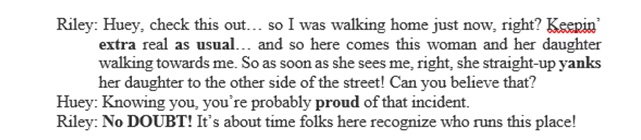
Riley Freeman is Huey’s younger brother but also his main target – Riley is exactly the kind of person Huey wants to change: a stereotypical Black wanna-be-rapper-gangsta-thug-pants on the ground-f-society-militant… who’s also just a third grader. Often referring to himself as Riley Escobar and Young Reezy, Riley Freeman assumes the persona of the image of gangsta rappers and thug life as depicted on television and the media, obsessed with jewelry, money, and bad rap music. But by making him eight years old, McGruder appears to magnify the silliness of the grown men who act in real life the way this child acts in a comic.
Riley Freeman is Huey’s younger brother but also his main target – Riley is exactly the kind of person Huey wants to change: a stereotypical Black wanna-be-rapper-gangsta-thug-pants on the ground-f-society-militant… who’s also just a third grader. Often referring to himself as Riley Escobar and Young Reezy, Riley Freeman assumes the persona of the image of gangsta rappers and thug life as depicted on television and the media, obsessed with jewelry, money, and bad rap music. But by making him eight years old, McGruder appears to magnify the silliness of the grown men who act in real life the way this child acts in a comic.
Huey worries about war in the Middle East; Riley worries about 50 Cent and The Game’s “beef.” Huey asks Santa for reparations, Riley asks Santa for a Playstation 2 and a Rolex with diamonds. When Riley finally takes a political stance, it’s in favor of the NRA. Clearly, he’s committed to his life’s main goal: “keepin’ it real” (1999).
Riley represents the socially stratified masses of Black youth that mindlessly follow and emulate media representations of what is “cool” and “hot.” Below is a clip of the way Riley thinks, acts, and moves through society.
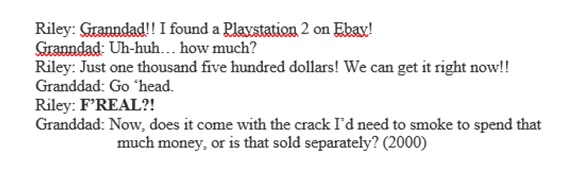
Robert Jebediah Freeman, a.k.a. Granddad, is the grandfather of Huey and Riley Freeman and the caregiver of the boys. Granddad is the freedom struggle-I know everything about the struggle because I marched for justice in the Civil Rights era- still- beaten down to bow down to the White Jesus mojo of Jim Crow Stereotype. He represents the older generation who struggled for freedom in the 60’s, but now he’s become disillusioned and tired of always worrying about The Good Fight. He’s the first to tell Huey that he tunes out his “white man’s conspiracy” rants, and he’s the stingy opposite of ostentatious Riley, refusing to turn on the heat even in 30-degree weather. He spends much of his time watching soap operas, dreaming about Dorothy Dandridge, and grumbling about his grandchildren. Freeman has since become wealthy and no longer has to work, but he is still miserable. He might have lost hope in change as cannot seem to understand the newer generation’s lack of respect for money and work ethic (or why rappers always look so angry). As the kids’ legal guardian and parental figure, he takes charge when he has to by threatening the kids with strict discipline, and he is just as sharp with his humor as his grandchildren are:
Freeman holds on to old ways of thinking and doing — he struggles with accepting change and new ideas from Riley or Huey. Granddad expects more and more out of life while still feeling “oppressed.” But no matter how strict or grumpy he may be, he does represent a generation which should be respected despite their some of their different views. Below is an excerpt into Robert Jebediah Freeman’s perceived reality.
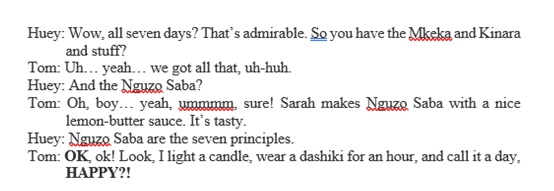
The character of Tom DuBois causes pause for thought and reflection as many black viewers wonder about his strange blend of black intellectual and scholar W.E.B. DuBois and the notion of “Uncle Tom.” This further pushes the irony of his name with DuBois’ idea of “double consciousness” which affects Tom in some strange and hilarious but confusing ways. His naiveté about white America and the American dream is typical of Black males who appear to have accepted European culture as their own. The Dubois family, headed by Tom, is the stereotypical depiction of an upper middle class Black male, swallowed up by capitalists and Eurocentric idealism so much that he no longer identifies with issues affecting Black America but tries to overcompensate when he actually tries, though almost always just to prove his “blackness” to Huey.
Tom’s attitude and stature is that of a typical conservative White man, disconnected from issues of the poor, and he is married to Sandra, a blonde-haired white woman who’s the authoritative figure in the household. They have a child, Jazmine who struggle with her own identity in reference to race, and all together, they serve to show how complicated the issue of race really is. Who’s “black enough?” How many ways are there to be black?
Uncle Ruckus, though, is either the most or least confusing character in the strip.
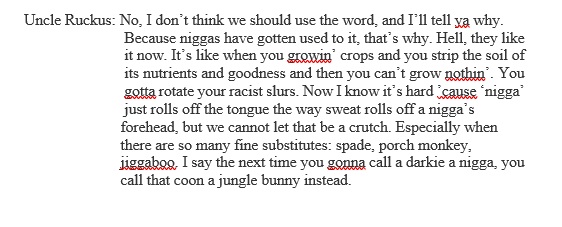
He is the epitome of what Malcolm X described in the 1960’s as a House Nigga. Uncle Ruckus, one of The Boondocks’ antagonists, is a bitter old Black man who hates anything and everything Black, and his hate is loud, rude, and stank. He prattles on and on about the beauty of white culture.
Often spouting White supremacist rhetoric, Ruckus is a hyper-hybridization of the racialized and radicalized self-hate that many Black males in America suffer from. Below is an excerpt of Uncle Ruckus’s response when asked if he supported the use of the word “nigga”.
Although he and Granddad belong to the same generation, McGruder shows the parallels between the two older men to remind readers that just because a person is older doesn’t mean he or she always knows best – same struggle, different methods.
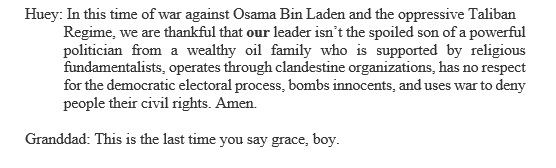
Following the events of September 11th, 2001, Huey Freeman became the voice of leftist America by holding onto his cynicism instead of jumping on the war bandwagon; He calls Dick Cheney “just plain creepy” and Condoleezza Rice someone who “works for a man who disenfranchised thousands of black voters and personally wrecked the world conference against racism,” and he even hinted at the similarities between George W. Bush and Osama Bin Laden:
The aftermath of 9/11 fired up racist, anti-immigrant sentiments, particularly against Muslim communities. Not only did the Islamic community face severe backlash in the forms of vandalism, hate crimes, and panic-inducing rhetoric, but so did any group of people who “looked” Muslim, such as Indian-Americans or American Sikhs, since many Americans lacked the ability to tell one brown person from another. These groups sometimes avoided public places or scrambled to fill their homes and cars with American souvenirs and flags as reminders that they, too, sing America. While some bravely stood up to fight such paranoia and rage, others were afraid to jump right into a critique of America’s response to this widespread Brown Panic.
Thankfully, black America had been perfecting resistance and subversion for much longer, and by the end of the 90’s, both Huey and McGruder were finally ready the moment they’d been waiting for. McGruder’s satirical comments about our country, the Bush Administration, the Iraq War, and the attitudes of certain sects of white Americans helped readers of his work process the confusion, anger, and pain following the disaster and the damage it left behind..
The Boondocks might have been both celebrated and censured, but no one can deny that it was noticed. By incorporating various facets of the black male, and arguably, black society as a whole, into one comic strip, McGruder balanced each character with another in order to show both sides of each issue presented to comment on race through the lenses of childhood, age, and the often humorous ways some of the major problems of American society play out. But underneath the hilarious clapbacks and silly situations is a darker, more cynical world view. Perhaps the humor allows his readers to walk away more informed but in a better mood, more prepared to notice the cracks in the wall, more ready to call out bad or unproductive behavior/distractions, and more likely to be engaged in the larger conversations about race and politics in America that we’d have even more of in the new millennium.
— Jihad Uhuru and Radhika Nataraj
References
Duhan, R. (2015). The Relationship between Literature and Society. Language In India, 15(4), 192-202.
Moore, M. (2003). Aaron McGruder’s Right to Be Hostile. Nation, 277(16), 20-21.
Sommers, J. M. (2014). The American Comic Book. Ipswich, Massachusetts: Salem Press
https://www.reddit.com/r/theboondocks/comments/1qiocu/critical_analysis_of_the_boondocks/.
http://uppitynegronetwork.com/2010/07/08/a-character-case-study-of-the-boondocks-the-dubois-family/
The Cosby Show premiered in 1984 on NBC and quickly became a staple in television history. The show featured comedian Bill Cosby and based a lot of its episodes on Cosby’s personal life. Although the show, a sitcom featuring the Huxtable family, a prominent black family living in Brooklyn, New York, reached its end in 1992, it influenced not only television, but also the view of the black family in the 90s. Millions of people looked up to Cliff and Clair Huxtable. This fictional family was the epitome of black success. The Huxtables had respectable professions (obstetrician and lawyer) and reared five obedient, for the most part, children. The show portrayed a view of the black family that was rarely seen on T.V., an entirely positive aesthetic.
TV Guide said the show “was TV’s biggest hit in the 1980s and almost single-handedly revived the sitcom genre.”[i] No truer words were spoken. The CosbyShow broke the mold and went on to spawn other popular black family sitcoms in the 90s such as, Family Matters and The Fresh Prince of Bel-Air. Both sitcoms featured loveable characters like Steve Urkle and Will Smith, but they also carried on the model of The Cosby Show. The families were middle to upper-middle class professionals, and the children had their faults, yet were, for the most part, model young adults. The children made mistakes, but learned from them. Both The Fresh Prince of Bel-Air and Family Matters proved to be positive influences of the black family in the 90s. The era of black consciousness made its mark on more than film, music, and literature. It permeated into mainstream television, too.
The New York Times credits The Fresh Prince of Bel-Air with putting rap on the map and reinforcing the themes in raps’ biggest songs of the 90s in a different way. “We will start to deal with some of the same things as N.W. A., Public Enemy, Ice Cube, and artists with a much more radical way of communicating their life style. But we’ll do it Will’s way, rather than in their language.”[ii] The show addressed issues that plagued the black community, such as racial profiling and vigilante justice. Audiences were entertained by Carlton’s naiveté, Hiliary’s spending habits, and Will’s jokes, but they were also enlightened. The world could look on and experience the era of black consciousness in an unassuming way.
The Big 3 of Black sitcoms opened the door for black families on television, and the 90s saw an explosion of representation of black families. Shows like Hanging with Mr. Cooper, Moesha, and Smart Guy featured families that weren’t technically nuclear. Hanging with Mr. Cooper and Smart Guy featured families with single parents raising children to the best of their abilities with the help of the community around them. Though the titular Mr. Cooper had no children, he acted as a father figure and friend to Nicole, the child of single mother, Georgia, and other kids in the neighborhood. Moesha and Smart Guy dealt the life after the death the family matriarch, and life after such a tragedy. These sitcoms presented different configurations of the Black family that were still positive and uplifting.
However, after The Cosby Show, The Fresh Prince of Bel-Air, and Family Matter in 1998, the picture of the black family in America diminished. Television has evolved. Shows like Empire, Love and Hip Hop, Basketball Ball Wives, and The Real Housewives of (insert city) are the portrayals of black family seen today. The black family is seriously misrepresented. It is broken and dysfunctional at best. Black women on TV are unmarried and can’t find a man, and the men are untrustworthy players with multiple children. People can argue that “families” such as this exist in America, yet it’s not all that exists so it’s not all that should be portrayed (or the majority of what is portrayed). So what happened to empowering black women? Black men? Black children? The black family? Where’s the sense of black consciousness that infected the 90s? The Fresh Prince was raised by a single mother and barely knew his father, but he had a support system and family in uncle Phil, aunt Vivian, and his cousins. The show exposed the bad, but showed there can be good too.
With the black family’s downfall came the demise of the view of the ultimate black patriarch, Bill Cosby. Since 2000, Bill Cosby has faced sexual assault and abuse, rape, and drug allegations from over fifty women that he encountered before and during the pinnacle of his career. These allegations have rocked the black community and torn people apart, supporters and now naysayers of Cosby. During The Cosby Show’s reign, no one would have conceived that Bill Cosby, Mr. Huxtable, loveable father and doting husband would fall from grace. Yet, he has. No matter what one chooses to believe about him, he has fallen, hard. The beginning of Cosby’s assault allegations coincides with the end of the black family on TV.
In the year 1903, the great black intellectual W. E. B. Du Bois presented the idea of “double consciousness” in his book entitled The Souls of Black Folk. He was simply referring to the belief that blacks living in America saw themselves in two different aspects. These aspects were both African and American. Although the term “Negro” was still used during the time of Du Bois, his concept of double consciousness way able to provide foundation elements to the term that later became known as “African-American”. Throughout history there have been many terms to describe groups of people. For the black people born and raised in the United States, this has definitely been true. From slave, nigger, negro, to black, these particular words have all been used to describe a particular race. Fast-forward to the year 1988, when the Rev. Jesse Jackson held a news conference encouraging the use of the term African-American. This particular term to define a certain race would go on and cause much debate and controversy throughout the 90s, even to the present day.
Jesse Jackson’s decision to use the term African-American spoke to a large group of people, but at the same time gained a lot of disapproval. The 90s were very important as it relates to the image of blacks being promoted to the world. Coming up with the “correct” term to call entire race was not easy due to individual personal beliefs. The idea of moving away from the term “Black” seemed to take the political approach and get rid of an entire history. This definitely did not sit well with people who considered themselves black and as a collective people throughout the diaspora with a shared struggle. On the other hand the term African-American was found best suitable for some because of the belief that the United States had made progressive steps since the Civil Rights Movement to consider a marginalized race citizens. While there were debates about what term to use, one of the most important things was exactly how a race was being treated by “its” country.
The 90s witnessed everything from the popularity of the Cosby Show to a resurgence of Black Nationalism beliefs. Both aspects represented the many different people that made up a race. The term African-American eventually became nationally recognized in 1997 by the United States government. Although the term was recognized by the government did not mean that everyone was on board. The same government that had recognized the term was the same government that was still plagued with different aspects of discrimination. Overall, the term African-American is still debatable and there has been individuals pushing for the idea of just being considered American in more recent times. Only time will tell if the term African-American will be around in the future or become a thing in the past like previous terms used to describe a race of people. – Andy Reid
“Either they don’t know, don’t show, or don’t care about what’s going on in the hood” were the words spoken by the young black-male character named “Doughboy” in the 1991 John Singleton directed movie entitled Boyz N the Hood. Although Doughboy was referring to the nonexistent news coverage of the murder of brother “Ricky”, his words spoke to an entire Los Angeles culture that filled was filled sex, drugs, gang violence, and police brutality. Director John Singleton is able to capture a very unique time in history as it relates to black 90s culture and he is also able to bring the world into the everyday life of a young black male growing up in the streets of South Central, LA. The theme of Boyz N the Hood is able to be presented through the eyes of the main character “Tre Styles” and this particular movie is able to be deemed a “hood classic” by its viewers.
The year 1991 was a very critical year as it relates to race relations in the United States. Racial tensions in 1991 rose to high levels after the brutal beating of Rodney King by the Los Angeles Police Department (LAPD). This particular incident was able to spark serious conversations surrounding race in America. From “political” rap to “hood” films the issues of Rodney King and the LAPD were addressed. The film was able to put numerous stereotypes on display while at the same time having a message for the viewer. In a time when the world had its eye on Los Angeles, Boyz N the Hood was able to take advantage of that while the world was watching.
Throughout the film, there are a number of memorable moments that showcase black love, black families, and black violence. Each scene is able to incorporate one of these particular elements and tie it back to the overall theme of black culture in the 90s. One of the most heart wrenching scenes from the film is when the character Ricky is murder by what appears to be members of the California-created gang “The Bloods”. Being murdered on the same day his above average SAT scores came in the mail, Ricky represents the good kid that played football, but is still not exempt from the everyday struggle of the “hood”. On one hand John Singleton is able to show that even the hood cries after Ricky’s death, but he is also able to showcase the numbness of death and that retaliation is mandatory. By allowing one of the “positive” characters to die in the film, Singleton promotes the idea that bullets do not have any name on it which definitely resonates with the black lives taken throughout the 90s.
Rather it’s the individual story of Doughboy or the story of Tre Styles who had an active father and mother in his life, the viewer is able to find one major similarity between the two. This similarity is that both characters were black men living in a country that deemed their life less important. Boyz N the Hood continues to push this particular belief throughout the movie as a way of putting the “truth” in society’s face. This is what makes the film highly important because it does not “sugarcoat” the politics that were going on in America during the time. It forces the viewer to come outside of their comfort zone which much of the different forms of art did in the 90s. There have been many that have argued that films such as Boyz N the Hood have added to the destruction of black culture, but depending on who is asked, the film simply pulls back the veil that has covered the issues surrounding black communities. —Andy Reid