
In 1996, one hundred and fifty four years after the first ever comic strip, The Adventures of Obadiah Oldbuck, was printed in the United States, African-American writer, producer, and cartoonist Aaron Mcgruder’s satirical comic strip The Boondocks exploded onto the scene via hitlist.com, an online music site. The following year, it ran in the monthly hip-hop magazine, Source. On November 6, 2005, The Boondocks jumped from print to an animated cartoon series on Cartoon Network’s night-time block, Adult Swim, due to its popularity. Boondocks ran for four amazing seasons, with fifty-five episodes in syndication. Finally, a comic strip that was made of the lore of African-American life, one which reflects African-American society, its good values and its ills, had arrived. McGruder’s take on Black life in America was unapologetically satirical and honest in its examination of issues which have plagued black Americans for hundreds of years.

The Boondocks is the story of two brothers Huey and Riley Freeman who move from the ravaged ghettos Southside of Chicago to the upper-crust city of Woodcrest, a fictional suburb of Baltimore, Maryland, to live with their grandfather in hopes of a better life.

The Boondocks serves as a sharp critique of American society delivered by its six major characters. Each character is an on-point caricature of black stereotypes that dominate our society’s collective sub-conscious, and its male characters serve as hyper versions of Black male stereotypes in America – stereotypes that Black America and society could not only laugh at but take an introspective look at the views and concerns of African-American males. McGruder seems to believe that studying this kind hyper-hybridization closely can lead to the development of some solutions to the many problems black people in America still struggled to solve.
Huey Freeman was named after Huey P. Newton, famed leader of the Black Panther Party for self-defense and represents a hyper-hybridization of the 60’s and 70’s stereotypes of The Black Militant and The Black Nerd. Huey, a highly intelligent ten- or eleven-year-old, claims he is “the antithesis of black popular culture… the anti-cool… a nerd!” Described as the boy who never smiles, Huey represents the ultimate black radical, the scholar, always on the lookout for the Klan, Whitey, and problematic black people. He is his own brand of pessimistic idealism — the voice that no one wants to hear but one they should listen to, nonetheless.
Huey does not play: he confronts The Man’s manipulation of the system which keeps black people from receiving the same freedoms and access to privilege He does. The eldest Freeman brother seems convinced that Santa Claus is a member of The Illuminati (2001) and does his best to keep other kids as “woke” as possible. He refuses to cut or trim his afro (or the front lawn), as doing so would mean conforming to Western standards of beauty, and he has worked out a plan to “overthrow an imperialist capitalist regime and replace it with a socialist system which recognizes and protects the collective good against personal avarice.”
He also angers his own community, though, by mocking them. He creates “The Most Embarrassing Black People Awards,” hates on Diddy and B.E.T., and lashes out against Cuba Gooding, Jr. for being a Sambo. But he isn’t just being contrarian for the sake of being contrarian: he wants to expose the greed and apathy of the public figures people admire so people will realize that the need to stop getting distracted and focus on what’s important since no one else is looking out for them – that minorities here have to fend for and protect themselves. He aims to lead by example and show people they’re allowed to ask more from their fellow citizens and their country.
https://www.youtube.com/watch?v=vDe-i4hqCfo
However, every now and then, Huey realizes the futility of trying to solve deep-rooted, institutional problems and becomes overly angry and skeptical. Huey Freeman is critical of everything and everyone, and as a result, he’s often teased or dismissed for being difficult to handle. Here, the hyper-hybridization shows readers that anger and wokeness aren’t as effective alone – the real messages, usually hidden by those emotions, need to be delivered in ways that people can understand and relate to.
Huey’s little brother, Riley, though, ain’t into all that.
Riley Freeman is Huey’s younger brother but also his main target – Riley is exactly the kind of person Huey wants to change: a stereotypical Black wanna-be-rapper-gangsta-thug-pants on the ground-f-society-militant… who’s also just a third grader. Often referring to himself as Riley Escobar and Young Reezy, Riley Freeman assumes the persona of the image of gangsta rappers and thug life as depicted on television and the media, obsessed with jewelry, money, and bad rap music. But by making him eight years old, McGruder appears to magnify the silliness of the grown men who act in real life the way this child acts in a comic.
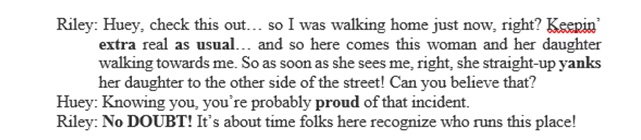
Riley Freeman is Huey’s younger brother but also his main target – Riley is exactly the kind of person Huey wants to change: a stereotypical Black wanna-be-rapper-gangsta-thug-pants on the ground-f-society-militant… who’s also just a third grader. Often referring to himself as Riley Escobar and Young Reezy, Riley Freeman assumes the persona of the image of gangsta rappers and thug life as depicted on television and the media, obsessed with jewelry, money, and bad rap music. But by making him eight years old, McGruder appears to magnify the silliness of the grown men who act in real life the way this child acts in a comic.
Huey worries about war in the Middle East; Riley worries about 50 Cent and The Game’s “beef.” Huey asks Santa for reparations, Riley asks Santa for a Playstation 2 and a Rolex with diamonds. When Riley finally takes a political stance, it’s in favor of the NRA. Clearly, he’s committed to his life’s main goal: “keepin’ it real” (1999).
Riley represents the socially stratified masses of Black youth that mindlessly follow and emulate media representations of what is “cool” and “hot.” Below is a clip of the way Riley thinks, acts, and moves through society.
Robert Jebediah Freeman, a.k.a. Granddad, is the grandfather of Huey and Riley Freeman and the caregiver of the boys. Granddad is the freedom struggle-I know everything about the struggle because I marched for justice in the Civil Rights era- still- beaten down to bow down to the White Jesus mojo of Jim Crow Stereotype. He represents the older generation who struggled for freedom in the 60’s, but now he’s become disillusioned and tired of always worrying about The Good Fight. He’s the first to tell Huey that he tunes out his “white man’s conspiracy” rants, and he’s the stingy opposite of ostentatious Riley, refusing to turn on the heat even in 30-degree weather. He spends much of his time watching soap operas, dreaming about Dorothy Dandridge, and grumbling about his grandchildren. Freeman has since become wealthy and no longer has to work, but he is still miserable. He might have lost hope in change as cannot seem to understand the newer generation’s lack of respect for money and work ethic (or why rappers always look so angry). As the kids’ legal guardian and parental figure, he takes charge when he has to by threatening the kids with strict discipline, and he is just as sharp with his humor as his grandchildren are:
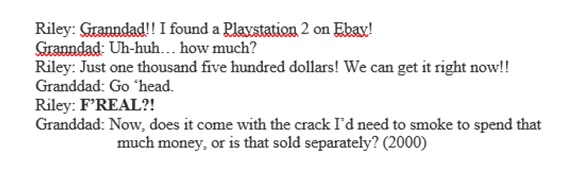
Freeman holds on to old ways of thinking and doing — he struggles with accepting change and new ideas from Riley or Huey. Granddad expects more and more out of life while still feeling “oppressed.” But no matter how strict or grumpy he may be, he does represent a generation which should be respected despite their some of their different views. Below is an excerpt into Robert Jebediah Freeman’s perceived reality.
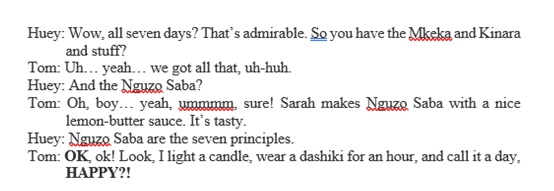
The character of Tom DuBois causes pause for thought and reflection as many black viewers wonder about his strange blend of black intellectual and scholar W.E.B. DuBois and the notion of “Uncle Tom.” This further pushes the irony of his name with DuBois’ idea of “double consciousness” which affects Tom in some strange and hilarious but confusing ways. His naiveté about white America and the American dream is typical of Black males who appear to have accepted European culture as their own. The Dubois family, headed by Tom, is the stereotypical depiction of an upper middle class Black male, swallowed up by capitalists and Eurocentric idealism so much that he no longer identifies with issues affecting Black America but tries to overcompensate when he actually tries, though almost always just to prove his “blackness” to Huey.
https://www.youtube.com/watch?v=g3m8eqwQ-Ds
Tom’s attitude and stature is that of a typical conservative White man, disconnected from issues of the poor, and he is married to Sandra, a blonde-haired white woman who’s the authoritative figure in the household. They have a child, Jazmine who struggle with her own identity in reference to race, and all together, they serve to show how complicated the issue of race really is. Who’s “black enough?” How many ways are there to be black?
Uncle Ruckus, though, is either the most or least confusing character in the strip.
He is the epitome of what Malcolm X described in the 1960’s as a House Nigga. Uncle Ruckus, one of The Boondocks’ antagonists, is a bitter old Black man who hates anything and everything Black, and his hate is loud, rude, and stank. He prattles on and on about the beauty of white culture.
https://www.youtube.com/watch?v=a4KAiylLzMc
Often spouting White supremacist rhetoric, Ruckus is a hyper-hybridization of the racialized and radicalized self-hate that many Black males in America suffer from. Below is an excerpt of Uncle Ruckus’s response when asked if he supported the use of the word “nigga”.
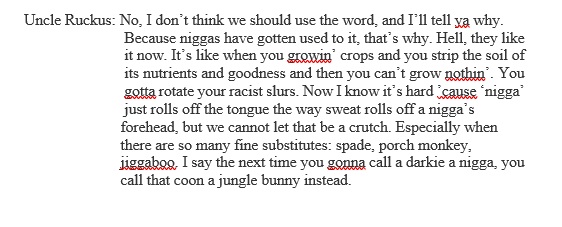
Although he and Granddad belong to the same generation, McGruder shows the parallels between the two older men to remind readers that just because a person is older doesn’t mean he or she always knows best – same struggle, different methods.
Following the events of September 11th, 2001, Huey Freeman became the voice of leftist America by holding onto his cynicism instead of jumping on the war bandwagon; He calls Dick Cheney “just plain creepy” and Condoleezza Rice someone who “works for a man who disenfranchised thousands of black voters and personally wrecked the world conference against racism,” and he even hinted at the similarities between George W. Bush and Osama Bin Laden:
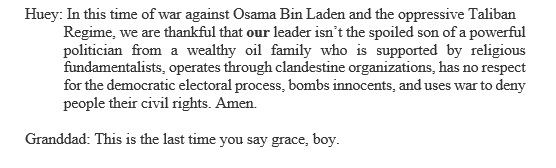
The aftermath of 9/11 fired up racist, anti-immigrant sentiments, particularly against Muslim communities. Not only did the Islamic community face severe backlash in the forms of vandalism, hate crimes, and panic-inducing rhetoric, but so did any group of people who “looked” Muslim, such as Indian-Americans or American Sikhs, since many Americans lacked the ability to tell one brown person from another. These groups sometimes avoided public places or scrambled to fill their homes and cars with American souvenirs and flags as reminders that they, too, sing America. While some bravely stood up to fight such paranoia and rage, others were afraid to jump right into a critique of America’s response to this widespread Brown Panic.
Thankfully, black America had been perfecting resistance and subversion for much longer, and by the end of the 90’s, both Huey and McGruder were finally ready the moment they’d been waiting for. McGruder’s satirical comments about our country, the Bush Administration, the Iraq War, and the attitudes of certain sects of white Americans helped readers of his work process the confusion, anger, and pain following the disaster and the damage it left behind..
The Boondocks might have been both celebrated and censured, but no one can deny that it was noticed. By incorporating various facets of the black male, and arguably, black society as a whole, into one comic strip, McGruder balanced each character with another in order to show both sides of each issue presented to comment on race through the lenses of childhood, age, and the often humorous ways some of the major problems of American society play out. But underneath the hilarious clapbacks and silly situations is a darker, more cynical world view. Perhaps the humor allows his readers to walk away more informed but in a better mood, more prepared to notice the cracks in the wall, more ready to call out bad or unproductive behavior/distractions, and more likely to be engaged in the larger conversations about race and politics in America that we’d have even more of in the new millennium.
— Jihad Uhuru and Radhika Nataraj
References
Duhan, R. (2015). The Relationship between Literature and Society. Language In India, 15(4), 192-202.
Moore, M. (2003). Aaron McGruder’s Right to Be Hostile. Nation, 277(16), 20-21.
Sommers, J. M. (2014). The American Comic Book. Ipswich, Massachusetts: Salem Press
https://www.reddit.com/r/theboondocks/comments/1qiocu/critical_analysis_of_the_boondocks/.
http://uppitynegronetwork.com/2010/07/08/a-character-case-study-of-the-boondocks-the-dubois-family/
Jihad S. Uhuru
