So Anxious: Black Love & Intimacy in Black R&B Music Videos


What does Black love feel like?

Many of us have grown up listening to sultry sexy artist like D’Angelo, Jodeci, Janet Jackson, Sade, Ginuwine and SWV. These are just a few of many R&B artists that have provided the perfect soundtrack to serenade your lover. If you had the perfect night in with your lover, D’Angelo’s “Brown Sugar” or Monica’s “Angel of Mine” probably set the mood and help the one you loved most understand and sense what you were feeling. However, one important aspect of these artists and their passionate love songs is how the artist and director were both able to create an intimate imagery of Black love and sexuality that was nostalgic and beautiful.

What does Black love look like?

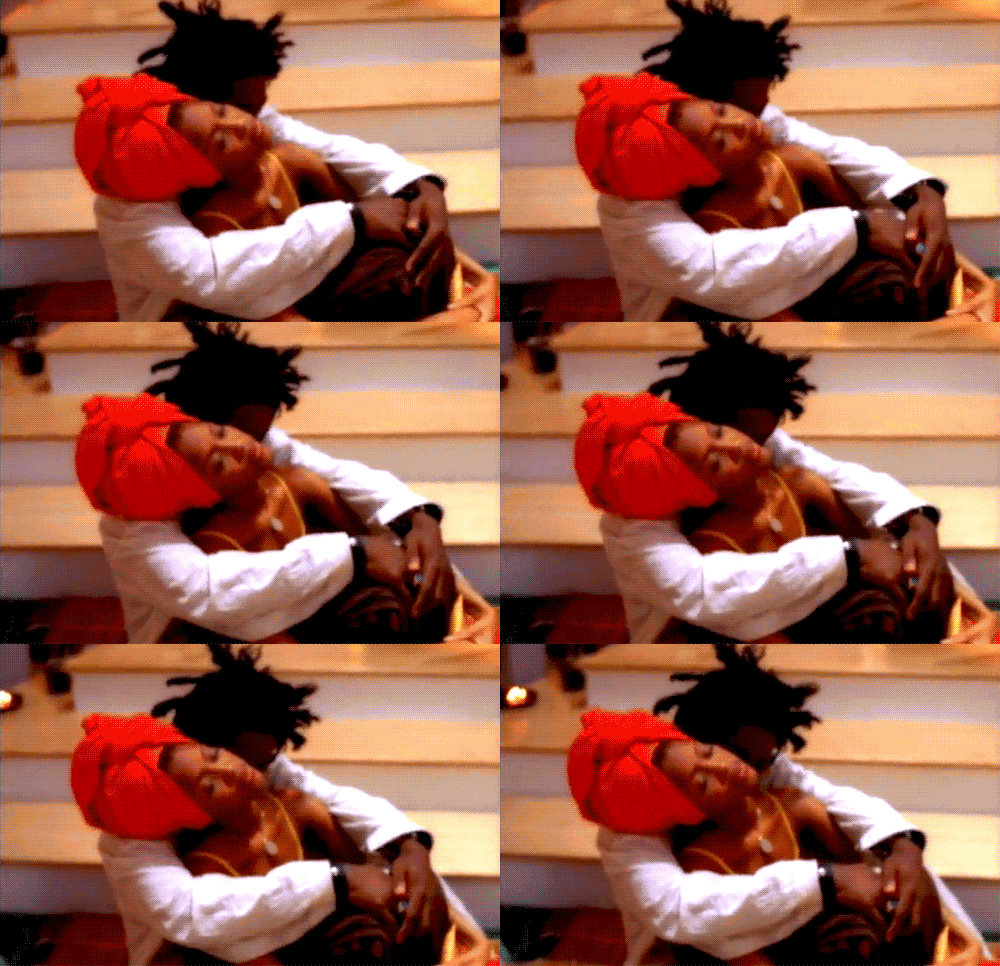
If I had to decide, to me it looks like Erykah Badu and Andre 3000 in her 1997 song “Otherside of the Game”. Erykah describes the commitment and love she has for her Black man and the things she goes through as the girlfriend of a drug dealer. In the video, you see a pregnant Erykah and a busy Andre 3000 co-existing in their loft starting their day. Importantly, this song provides an iconic soundtrack to what they are experiencing that morning along with showcasing their love as she wakes Andre up, they play fight, he caresses her belly and holds her tight as they embrace. This video provides an everydayness of waking up together and loving each other where others who watch the video can resonate with.
I also think in Joe’s video, “All The Things Your Man Wont Do”, there is sex appeal and curiosity between him and his lover.  In the beginning, you see Joe confessing his love to a woman on a pay phone and telling her that she deserves better.

This inevitably leads him to make an appearance at her job where he continues to serenade her and convince this Black woman that he possesses qualities that her current boyfriend does not. Throughout the video, the director creates a late-night mood and intimacy that is shared between the two. This is seen in the way the young woman flirts with Joe in the restaurant and making the ultimate sacrifice to take a chance with a better man

How far will Black love go?
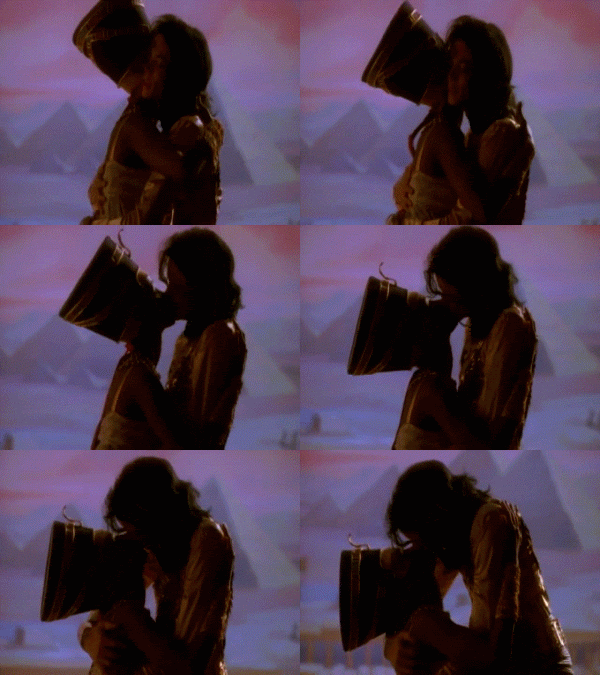
A classic R&B music video that had a more scandalous storyline, but still had meaningful lyrics was Michael Jackson’s “Remember the Time”. Boyz n the Hood director John Singleton, directed his first music video which was set in ancient Egypt and starred Eddie Murphy and supermodel Iman. Although Michael Jackson also serenaded someone else’s wife in the video, this video honored  Black people as rulers of ancient Egypt, the fight for love and an amazing dance sequence with both Black men and women of all shades. This video, in particular, reflects on the past of two lovers while still honoring the beauty of Black love and Blackness through the wardrobe selection and various skin tones of Black characters and dancers.

While many 90s artists brought us sexy and intimate love ballads, their music videos accompanied imagery that made you believe in Black love that was complicated, honest and sincere. While the videos discussed aren’t true to every relationship, these videos did portray a side of Black love and intimacy that wasn’t easily found in the typical raunchy Hip-Hop videos. R&B music videos were able to tastefully showcase all shades of Blackness that wasn’t necessarily misogynistic or overly provocative. However, it did showcase a variation of Black love and intimacy that took place in ordinary locations such as the subway, club or local coffee shop. A brotha would proclaim his love in the rain, or on the phone. A sistah would make a late night trip to her man’s crib or wake him up and sing to him in the early morning. Either way, watching and reminiscing on 90s R&B I’m sure one could find the perfect video that embodies and reflects how they feel about their Black love. — Adeerya J.

 

Sister, Sister: Sisterhood & Womanism in the 90s

Womanism: “Also: A woman who loves other women, sexually and/or nonsexually. Appreciates and prefers women’s culture, women’s emotional flexibility (values tears as natural counterbalance of laughter), and women’s strength. Sometimes loves individual men, sexually and/or nonsexually. Committed to survival and wholeness of entire people, male and female. Not a separatist, except periodically, for health.”[1]

Alice Walker     

A close friend told me being a Black woman is like being in a secret club of magic, sisterhood and friendship. Reflecting on Black women’s friendship and sisterhood on television and movies in the 90s, I, similarly see a consistent theme of support, unconditional love and acceptance.  These themes can be aligned to how Alice Walker describes a Black feminist in her definition of Womanism. Walker describes Womanism as young girl as “girlish” or  “womanish” or a black feminist or feminist of color. I find her description of Womanism as a means to provide a specific exploration into the lives of Black womanhood.

 I look specifically to Walker’s second definition because it captures the essence of the 90s Black woman who aims to take on the responsibility to be in charge of herself and to question the world around her. I reference how this can be explored in the hit show Living Single and the hit movie and book Waiting to Exhale. I utilize Walker’s second definition to explore how these women embody the spirit of being a womanist through the ways their characters interact with each other and how they stand alone as independent Black women loving and living in the 90s.

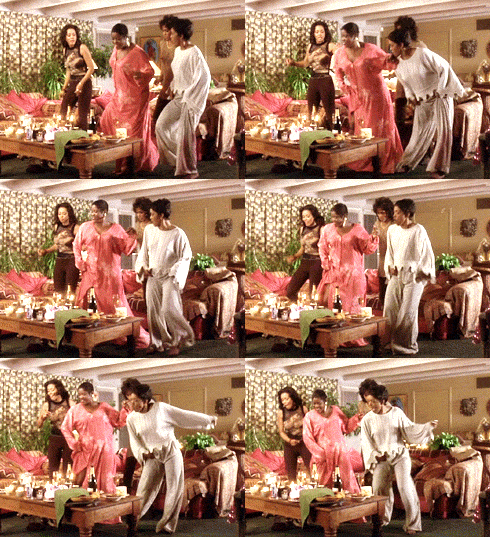
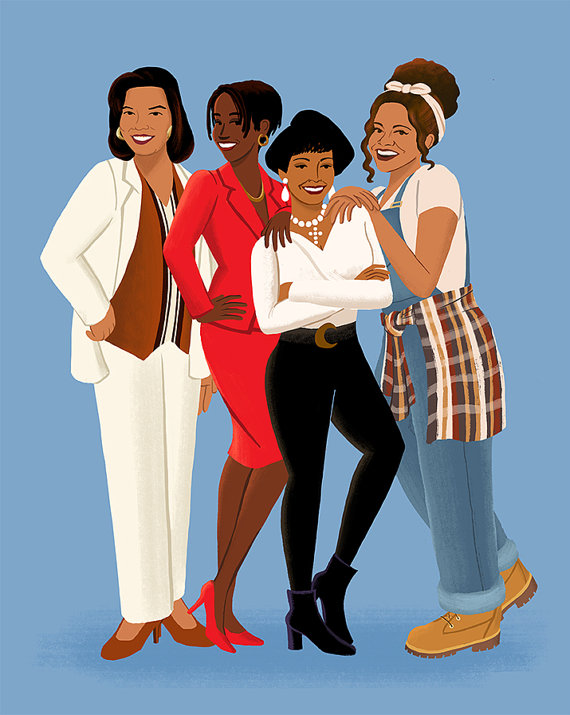
Looking at the lives of Khadijah James, Synclaire James, Regina Hunter and Maxine Shaw, Living Single explores the lives of four independent Black women in New York City. This show captures the “everydayness” of single Black women in New York who validated each other, dealt with love and relationships and enjoying each other’s company.

With each woman having their own characteristics and identities, each woman on the show had an important role in each other’s lives. Khadijah and Regina were childhood friends who supported each other when things got tough. This support and commitment were also fluid in Khadijah and Synclaire’s relationship as cousins who she employed at her own Hip-Hop magazine called “Flava”.

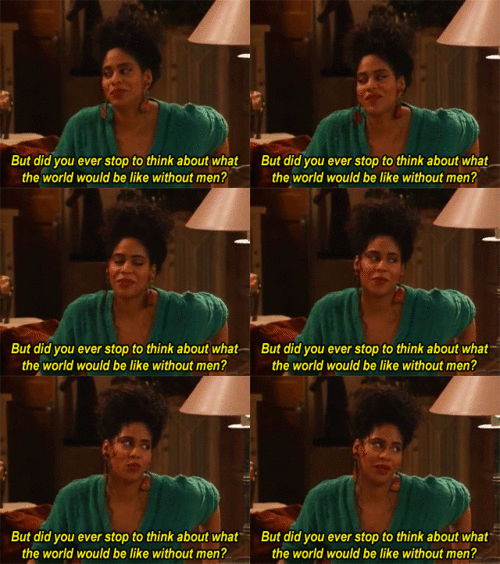
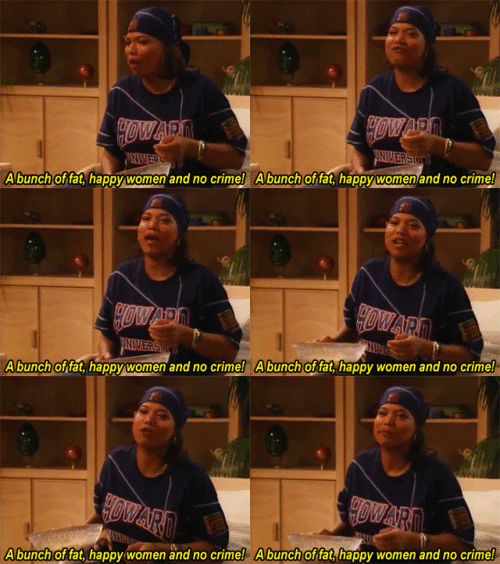
Maxie and Khadijah were college friends from Howard University and Maxie seemed to always be the advocate for strong independent Black women amongst her friends. Their friendship supports Walker’s definition because of the characters emotional flexibility, their commitment to women’s empowerment and their tough bond as friends that were seamlessly interconnected, through the best and worst of times.

Walker does a great job discussing the emotional and spiritual effort that goes into being a Womanist. Walker explains how Womanist appreciates women’s culture, loves women sexually and non-sexually and values a woman’s strength and weaknesses[2]. This is where the women in Terry McMillian’s Waiting to Exhale fit this definition. Savannah Jackson, Bernadine Harris, Robin Stokes and Gloria Matthews experienced tough trials of love, life and men. Through their experiences, the women supported each other through it all. There were words of affirmation and emotional support that showed people like Bernadine who was going through a terrible divorce that her friends were by her side.

I see Walker’s womanism as describing the social interactions, spiritual activism and critical thought that Black women do to uplift all people regardless of sexuality or gender. I understand this definition as a way to look at Black women’s liberation and healing of the self. Specifically, acting “womanish” seems to be a central theme in Waiting to Exhale. The four women were searching for answers to love, family and womanhood which is where I found the connection with Walker’s definition. This can be seen in Robin’s way of how she seemed to date the wrong men, but tried to see the best in them because she had love to give. Walker added the importance that a Womanist was not a separatist, but only in the occasion that Black woman in the 90s needs to repair her health. Gloria symbolizes the friend who represented self-care as a hairstylist and made sure her friends were always taking care of themselves, even if she didn’t want to do the big chop on Bernadine.

Furthermore, the importance of Walker’s definition and the analysis of  Black woman’s thoughts and feelings will better aid to the mental and emotional health and well-being where the Black woman can adequately take care of others and themselves in shows like Living Single and Waiting to Exhale. The womanist identity and the importance of Black women’s “everydayness” in the 90s was significant, interesting and relevant to highlighting the ugly and the beautiful of what it means to be a Black woman. These women work on coming into their own and being Black adult women who may not have it all figured out. But with the power of resilience, self-love and love for each other, the magnitude and power of their friendship kept them moving forward. — Adeerya J.

Citations

[1]Walker, A. (2006). Womanist. In L. Phillips, The Womanist Reader (p. 19). New York: Routledge.

[2]ibid.


The Real World Prototype and Reality TV

The Real World Logo

As a network developed to provide a new platform for music’s developing stars, MTV changed the lives of countless young artists looking for a break into the industry. During the 90s, MTV featured shows that primarily emphasized music: Yo! MTV Raps, MTV Unplugged, Alternative Nation, Club MTV, and Total Request Live are several programs that linked the entertainers and fans together by giving the fans control over what content aired. MTV’s popularity anchored itself in the young viewership of teens and young adults between the ages of 18-25; the pride of the network centered around creating a space dedicated to youth popular culture and the decade’s hottest rappers, rockers, and pop stars.

MTV also designed programming that focused on broader topics, like MTV News, in an effort to round out its offerings. The network’s longest running series, MTV’s The Real World, highlighted the day-to-day lives of young people from various backgrounds living together in a predetermined city. The show’s introductory tagline became ubiquitous with its content, and viewers could always count on an explosive combination of personalities to fuel each season’s unpredictable episodes:

“This is the true story of seven strangers, picked to live in a house, work together, and have their lives taped. Find out what happens when people stop being polite and start getting real…”

For twenty-five years, young people from different geographic locations and with varying backgrounds came together in cities throughout the country for our viewing pleasure, making The Real World the first successful reality television show broadcasted in America.

The Real World was modeled after Beverly Hills 90210 and Melrose Place, as an alternative to major network soap operas targeting middle-aged women. Mary-Ellis Bunim and Jonathan Murray, the show’s creators, opted for the “reality” format of The Real World, because their budget didn’t allow for writers, set design, actors, etc. So, they decided to let the participants create the storyline. The show’s first season was set in New York City and filmed over a three-month period, with each cast member receiving $2,600 for appearing on the show. And in New York, things got really real (well, at least according to mainstream TV content in the 90s).

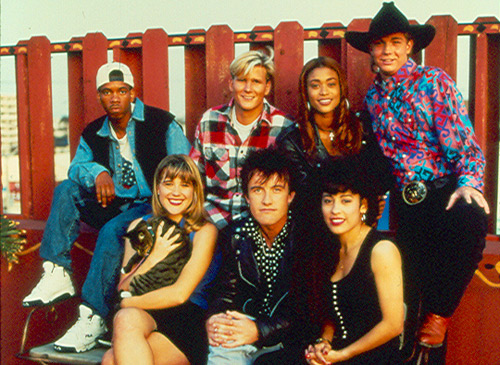
What later becomes typical behavior amongst The Real World castmates was exciting and fresh during its 1992 debut (and for a few seasons thereafter). The thirteen episodes of Season One show Becky, Kevin, Heather, Julie, Andre, Eric and Norman working through romance, sex, illness, familial relationships, and social issues. The roommates are divided by gender 3:4 (female-to-male), and 5:2 ethnically (with two African-American cast members). Race plays a factor is several episodes, with Kevin Powell leading many conversations that highlight divisions within the house. His (in)famous confrontation with roommate Julie Gentry demonstrates the organic manner in which controversy arose, making the episodes worth watching.

Norman Korpi, Andre Comeau, Julie Oliver, Rebecca Blasband, Heather B., Eric Nies and Kevin Powell of The Real World New York Cast (Photo by Ron Galella, Ltd./WireImage)

The abridged version of the confrontation goes as follows: Julie accused Kevin of threatening her with physical violence and spitting at her after she refused to let him use their house phone (remember: this show’s original airing predates cell phones and all things technologically mobile). He admitted to being upset with her but denied spitting at her. When Norman and Eric sided with Julie, Kevin pointed to race as the underpinning for Norman and Eric’s alignment with Julie, but Julie sited what she determined as Kevin’s past record of aggressive behavior as the justification for her sentiments. The parties later reached some type of amicable resolution, but this episode created a precedent later followed by other seasons, where not only race, but religion, gender, and sexual orientation often divided the castmates. The show’s best moments are those credited for opening up tough conversations among young people.

Future roommates, almost always from various upbringings and of different ethic backgrounds, would confront similar issues: race, gender discrimination, differences concerning sexual orientation, political beliefs, body image issues, and religion. In Season Two, The Real World: Los Angeles, castmates Tami Akbar (m. Roman, later star of VH1’s Basketball Wives) and David Edwards divide the house after what begins as a prank targeting Tami. The incident escalated to a physical confrontation between the cast members, ultimately resulting in the decision to remove David from the house.

The Real World may be credited as the pioneering reality television program, and its influence remains evident in various popular “reality” TV shows on various networks. While there’s a show out there for a number of interests—meant quite literally, as every network, from HGTV to The History Channel, offers some reality-based series— few strike more intrigue than those offering insight into Black culture. More specifically, many shows feature African-American women feigning friendships, chasing men, and digging into entrepreneurial endeavors. And no Black reality TV show is complete until an episode features a shade-throwing-, tea-spilling-, let-me-get-you-together-type confrontation. The entertainment factor is undeniable, though, as shows like Bravo’s The Real Housewives of Atlanta and VH1’s Love & Hip Hop have reached ratings as high as 4.3 and 3.8 million, respectively.

Bunim and Murray’s reality TV formula allowed for an organic plot-development (although film was edited to help establish a traceable storyline), and the issues the casts encountered mimicked situations relatable to the audience. As The Real World progressed, audiences criticized producers for what many perceived as scripted conflicts and contrived conversations. It seems, however, that recent reality TV shows are only popular if the drama is “too good to be true.”

Nonetheless, our favorite reality starlets are also feeling a little shade from their fanbases, too. Ratings for many shows reflect a decline in viewership over the years, and in an effort to remain relevant, many storylines have expanded far too far away from “reality” (Do they have to fight every week?). And more troubling, for some, is what’s frequently cited as a collective misrepresentation of Black woman and the threat of conveying a distasteful, inaccurate message to young Black girls about Black womanhood in America.

Because of a history of oppression, subservience, dispossession of the body, abuse, malicious sexual intrigue, and marginalization by American at-large, we may question if Black reality TV supports or disrupts the perpetual race- and gender-based pursuit of acknowledgement, acceptance, and encouragement of Black women (and other women of color) in society. Are these women our entertainers, role models, or stereotype perpetuators? —Shari Arnold


RHOA

LHHA Cast

References

<http://www.emmytvlegends.org/interviews/shows/real-world-the>

<http://www.usmagazine.com/entertainment/news/real-world-new-york-cast-reuniting-22-years-later-on-oprahs-show-20141712>

<https://lmarsh11.wordpress.com/tag/seven-strangers-picked-to-live-in-a-house/>

<http://www.theroot.com/articles/culture/2013/03/race_on_the_real_world_retro_mtv_and_social_issues.2.html>

<http://www.ibtimes.com/mtv-ratings-decline-raises-relevance-questions-young-people-cut-cable-cord-devices-1881468>

<http://allthingsrh.com/rhoa-ratings/>

<http://allhiphop.com/2015/05/08/is-love-hip-hop-languishing-in-ratings/>

Black to the Future: African American Sci-Fi Heroes in ’90s TV and Film

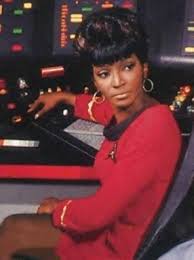
As Ytasha Womack points out in her book Afrofuturism: The World of Black Sci-Fi and Fantasy Culture, “it was an age-old joke that blacks in sci-fi movies from the ‘50s through the ’90s typically had a dour fate” (7). They were killed off: black hero, Ben (Duane Jones) in George A. Romero’s original The Night of the Living Dead (1968), is shot by the police at the end of the film. And white heroes trumped them: in Star Wars: Return of the Jedi (1983) Lando Carlrissian (Billy Dee Williams) looses the Millennium Falcon in a bet and, as an unfortunate result, Hans Solo (Harrison Ford) gets more screen time. Even in Star Trek: The Original Series (1966-69) — whose which creator, Gene Roddenberry, had openly articulated his investment in multiculturalism — Captain Kirk (William Shatner) repeatedly overshadows and even marginalizes Communications Officer Uhura (Nichelle Nichols), the only black character on the show (Kanzler). The prevalence of these tropes in other mainstream sci-fi series and films suggests that, in the words of Womack, “in the artistic renderings of the future by pop culture standards, people of color weren’t factors at all” (7).  However, mainstream ‘90s sci-fi seemed to take Roddenberry’s vision much more seriously. In particular, black men were given more representation and occupied more positions of power in futuristic settings.

uhura                 lando


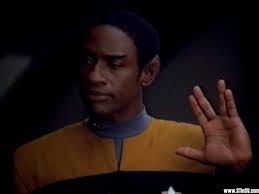
By 1999 Star Trek had been revived into three overlapping series that increasingly diversified. Star Trek: The Next Generation (1987-1994) still centered on a white hero, Jean-Luc Picard (Patrick Stewart), but it gave significant airtime to Lieutenant Commander La Forge (LeVar Burton of Roots and Reading Rainbow acclaim) and also introduced Worf (Michael Dorn), la forgethe only Klingon in Starfleet (though, I admit, the racial implications of Klingons might be problematic). Star Trek: Deep Space Nine (1993-1999) showcased the series’ first black captain, Captain Benjamin Sisko tuvok(Avery Brooks) and Star Trek: Voyager (1995-2001), arguably the most diverse Starship crew, had a black Vulcan chief of security and tactical officer, Lieutenant Tuvok (Tim Russ who, they say, bears some resemblance to President Barack Obama).

men in black

The mid 1990s transformed Will Smith from fun loving teen flirt in the family comedy series Fresh Prince of Bel-Air (1990-1996) into sci-fi action hero in the summer blockbuster Independence Day (1996) (making him one of highest grossing black celebrities in Hollywood). Smith followed Independence Day with two other sci-fi hits, Men in Black (1997) and Enemy of the State (1998). Around the same time, Wesley Snipes took to the big screen to play vampire superhero Blade (1998), and Lawrence Fishburne played the role of wise Morpheus in The Matrix (1999).[1] Wesley-Snipes-Blade-Leather-Coat-4-1200x1200

Hyper masculinized black men were finally saving the world on sci-fi screens, instead of being killed-off or sidestepped.  Yet there are important exceptions and integral supporting roles. Alfre Woodard played 21st century science and WWIII survivor, Lily Sloane, in Star Trek: First Contact (1996) and Gloria Foster played The Oracle in The Matrix. Vivica A. Fox played single mother, exotic dancer, and Will Smith’s love interest in Independence Day. Angela Basset won Best Actress at the Saturn Awards in 1995 for her role of Lornette “Mace” Mason in the film Strange Days (1995); Basset also played opposite Eddie Murphy in Vampire in Brooklyn (1995). Carol Christine Hilaria Pounder “CCH” played a freedom fighter Bertha Washington in Robocop 3 (1993) and FBI scientist, Dr. Hollis Miller, in Face/Off (1997).


mace   bertha washington


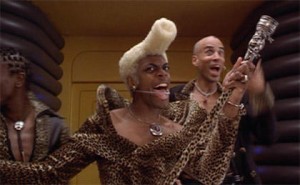
There were also gender-bending black sci-fi characters. The most famous, perhaps, is Ruby Rod (Chris Tucker) in The Fifth Element (1997). Yet, Dwight Ewell’s performance of “Hooper X”, a black queer comic book artist who pretends to be both masculine and militant, in Kevin Smith’s Chasing Amy (1997) remains seminal.

ruby rod


hooper x 1

hooper x 2

hooper x 4

hooper x 5

hooper x 6

hooper x 7

hooper x 8

Strangely, the 2000s has brought rather conservative reboots of the original Star Trek series. Uhura, now played by Zoe Salada, is still a supporting character and plays a marginal role on the Enterprise. However, with the reemergence of Octavia Butler and the advent of recent Afrofuturism, developed by women like Ytasha Womack and Janelle Monae, the future looks black, and even feminist.  —Rebecca Kumar


Footnotes and Works Cited

[1] originally written by black sci-fi screenwriter Sophia Stewart, who won a lawsuit against The Wachowski Brothers

Kanzler, Katja. Infinite Diversity in Infinite Combinations: The Multicultural Evolution of Star Trek. Universitatätsverlag Winter, 2004.

Womack, Ytasha L. Afrofuturism: The World of Black Sci-Fi And Fantasy Culture. Chicago Lawrence Hill Books, 2013.


Afrocentricity: A Commentary

In our discussion of 90s Black experiences and cultural expressions, the concept of Sankofa is important to consider for both reflection and analysis. Sankofa is a Twi term from the Akan peoples of mainly Ghana and Cote d’Ivoire, West Africa. The word is a verb meaning “to go back and fetch:” to retrieve important items previously lost, forgotten or stolen. In the context of one’s culture, the idea of Sankofa requires one to both re-learn and adapt crucial skills, collective understandings and overall lessons from his or her ancestors. From this process, it is understood that the person who does the “fetching” receives the power from those “items” of knowledge. The ultimate goal of this retrieval is for one to then project themselves and their descendants into the future, working from informed positions of self-reflection, self-knowledge and self-determination.

For African Americans, in-depth studies of both our historical and current experiences in this country reveal ongoing, consistent reenactments of this Sankofa concept. Documentation of developments in our music, education, fashion, social arenas, family practices – and more – prove our active revitalization and reincorporation of the ways of our ancestors: in Africa, the United States, the Caribbean, South America…wherever people of African descent landed globally, by force or by choice.  Our cultural expressions reveal the agency exhibited in sampling, remixing or reinventing what we have learned for practical application in modern times.

From this position, I wanted to tackle the concept of Afrocentricity – which as a term became prominent in the 1980s and 90s. There are many conflicting interpretations of this term, and its often conflated with Afrocentrism, African-centered thought, “Afro-“ vs. “Afri-”, and so on. This happens to the point where the idea of someone being “Afrocentric” entails a host of stereotypical tropes, caricaturing and misunderstandings. This is particularly evident in popular media of this time, as well as public reaction in many Black communities. 90s film characters like “Ahmal” in Sister Act 2, Damon Wayans’ “Conscious Brother” in “In Living Color” episodes, the dreadlocked player on A Different World, and many other examples would depict a kufi-and/or-dashiki-wearing individual spouting random historic statements about “The Pyramids”, ”the white man” or “Shaka Zulu.” Dressed in kente, mismatched colors and military-like gear, this type character would often act in arrogant, misinformed behaviors, which would ultimately isolate them from the larger Black community.

These tropes are a testament to the simplified nature of discussions and expressions relating to what are considered Afrocentric theories and praxis. For some it’s wearing traditional African clothing, for others it’s adopting African names – or also re-identifying with an African ethnic group or spiritual system. For many, its academic scholarship: focusing on prioritized pre-colonial African historical periods deemed “classical” or “enlightened” – above any other cultural expressions or achievements of any other group of people in the world. Conversely, many researchers of African and African Diasporic value systems, knowledge bases and cultures have sought to identify common threads amongst these intricate systems, in an attempt to create blueprints for strategic unification, productive cultural alliances, and community building for liberation and ultimate sovereignty. All of the actions mentioned in this paragraph are interlinked, and are products of individuals making either informed or uninformed choices to change their lives in a way that reconnects them to a cultural source. At the same time, we need to continuously reevaluate our ideas, and challenge ourselves to avoid recreating limiting, dogmatic or one-dimensional systems of cultural expression – where one organization deems themselves “more African” or “more Afrocentric” than the next, based on attire, ideology, spiritual practices, how many visits to Africa they made or how many books they’ve read on Black history.

In looking at the long history of our people in this country, and in the African Diaspora, we have infinite examples of resistance to oppression, reapplication of cultural expressions and innovative methods of growth and renewal. Viewing them all as equally important to consider keeps us from developing an essentialist trait of prioritizing some experiences over others: resulting in an Afrocentric definition that may confine, stereotype and simplify. In the United States, the respect-based process of learning about our families, communities and their solution-building strategies has helped us to overcome all obstacles to survive and go forward. This empowers us to progress with the informed appreciation and application of our African retentions, forms of knowledge and practices. —Kweku Vassall

RANT WARNING! lol: <I would also like to challenge this idea of one being “conscious,” a popular phrase in Black communities in relation to African-centered or Afrocentric thought. Conscious is often said as if all that needs to be learned has been learned – or that there’s this class of enlightened people who know-what-they-don’t-know-their-neighbor-also-knows, because one is so busy being “more informed”. Not to negate people coming to important realizations, BUT knowledge of oneself also deals with positive relationships with others, implementing practical solutions to problems, adapting in various environments and creating new knowledge to fit one’s current situation – all things Black people of all walks of life and ideologies have accomplished. This idea that a few are “awake” and the majority are “asleep” works within this larger misconception that up until recent years Black people were ignorant, chitlin-eatin (non-vegetarian) slaves who couldn’t observe their environments enough to notice oppression, or were disconnected from their ancestors and relatives to point where they had no appreciation for the family values and principles for survival passed down for their benefit. Our grandmothers and grandfathers may have experienced hell (in various class statuses and locations, obvious and hidden torments included), but at the same time, honoring our African ancestors teaches us that the experiences of our most recent African American relatives are valid and worthy or respect, honor and consideration. We should see them as active participants, not passive bystanders, in our history and cultural development. This is true especially considering the marginalization and oppression they faced, how they either thrived or psychologically crumbled as a result, and the sacrifices they all made for us to both be here AND have the privilege to operate in learning spaces to obtain further knowledge that was often hidden from them. It would behoove us to look back to the important information they knew, which can help us even more to face our current reality.>

The 90s Kente Aesthetic

Image from http://www.projectbly.com/destinations/kumasi/meet

The type of cloth we know as “Kente” originated in Ghana and Cote d’Ivoire, West Africa. Kente was/is mainly created by the Asante and the Ewe peoples, descending from the ancient empires of Ghana, Mali and Songhai from before the 15th century. These empires were located in the general area from the West African coast to as far north as Mali, and as far west as Chad. According to historian Herbert M. Cole, author of Icons: Ideals and Power in African Art (Smithsonian Institution publication), the term Kente may be a corruption of the Fanti word for “basket” – alluding to the hand-weaving process. Cole goes on to explain that only males create the long strips, on an intricate loom. Each design has a distinct name, with proverbs associated with particular patterns – wearing particular colors and shapes sends specific messages you want viewers to understand. Among the Asante and Ewe, kente was often associated with and reserved for chieftains and royal figures – fabric trades with Europeans provided materials for locals to rework into traditional designs. Unlike the 1980s and 90s, kente wasn’t originally sewn into garments for everyday wear (Cole 1990). This historical perspective gives greater context to the recent boom in kente cloth wear, and the newer ideas associated with these designs.

I can’t think of the 1990s without thinking of Kente. I remember being 6-7 years old and going to an independent school called Lotus Academy in Philadelphia. In our yearly closing graduation, students would wear kente sashes, kufis, bow ties and skirts for girls. We would march in the auditorium to Freedom Songs, chants of encouragements originally sung during the Civil Rights Movement. For us, and our parents, the colorful print cloth represented our link to the Motherland, to Africa: ideas of glory, achievement, kings and queens, and societal stability before enslavement/colonization. Wearing kente symbolized that we were continuations of these ideas, the charge that we could reinvent and achieve greatness as our ancestors did. This expression really took hold in popular culture, particularly with the continued rise of several elements:

…hip hop, with recording artists like Queen Latifah, Heavy D & The Boyz, Salt n Pepa (those kente hats!), other artists and fans who sported Cross Colours garb…

…the highlighting and celebration of black college campus culture, with kente prints as iconic motifs for newly-launched Black Studies program materials, “Class of 199_” sashes for African American Studies majors, and the like. With this imagery in academia, Black students tied this tradition to the charge to represent one’s family, community and ancestry – to learn about their past to create new solutions for the modern era.

…African motifs in television and mass media: Michael Jackson dons kente and stands with chiefs in Cote D’Ivoire in 1992. In 1998, President Bill and Hillary Clinton display their kente print during their Ghana visit. Black sitcoms, performances and Kwanzaa specials frequently featured characters who were up on the latest trends, wearing dashikis, kufis, lappas (waistwraps) and headwraps.

…Craft activity books for Black children: With Black history at the fore of many grassroots published workbooks, handouts, coloring books and illustrated stories for children, Kente symbolizes variety and diversity within the Black family and community. This larger theme is evident in a recent Ladybug magazine entry: an arts and crafts project of picture frame decoration. Colors and shapes in Kente are used to prompt young readers to think about the unity in difference amongst their own family members (Kapp 2007). Kente Colors, written by Debbi Chocolate and illustrated by John Ward, introduces small children to their basic colors – matched with poetry and elaborate illustrations of West African life scenes and kente-weaving (Chocolate 1997).

…African inspirations in high fashion and streetwear magazines – where it was often called “ethnic print” or “mustard” cloth. Adidas came out with a brand of kente cloth sneakers – to match the widespread popularity of “conscious” Black History t-shirts and sweaters. For high fashion tastes, prints were incorporated into elaborate dress patterns, tuxedoes, blazers and hats. In a 1990 edition of Black Collegian, Julia Wilson presents a spread featuring hot, new gear on the market. In her section “ Looking Good: Back-To-School with Ethnic Pride”, she notes the following:

“Historians have documented African culture in fashion from the Ashanti to the Zulu peoples. This gives all of us descendants a renewed sense of self in historical terms and inspirational knowledge of where creation began in the first place. From the mustard colored kente cloth being copied today by leading designers to braided and dreadlocked hairstyles, African people have – since the beginning of time – been at the center and forefront of fashion styles – passing along their zest for life through their creations.” (Wilson 1990)

Building on this quote, further interesting positions on this topic are presented by Cole, who posits that:

“..African Americans are now designing cloths, creating outfits, and marketing fashions that owe much to Africa, yet are not, in fact, African. The sensibilities in the Kente adaptations are modern and American-African-American. Surely it is appropriate for Americans whose ancestors lived in Africa, some in Ghana and Togo, to modify and celebrate a powerful African artistic tradition.” (Cole 1990)

Reflections on the popularity of kente raise a need for further analysis. A few questions surface with regards to this phenomenon in the 1990s. What can we learn about instances of cultural and symbolic appropriation with regards to African Americans adoption and revitalization of kente’s use? Is appropriation a valid term to even apply, given a broader question of identity – what is African culture? Who can access it? Can there even be a sole authentic African culture, or correct, authentic cultural elements? I couldn’t possibly answer these questions with this entry. However, I hope this discussion continues with folks to add their insight from both history and personal experience. —Kweku Vassall


Works Cited

Chocolate, D. (1996). Kente Colors. New York, NY: Walker and Company.

Cole, Herbert. M. (1990). Kente: A Meaningful Tradition in Cloth. American Visions, 5(5).

Kapp, Jody. (2007). Kente Cloth Frame. Ladybug (Magazine), 17(7), 37.

Wilson, Julia. A. (1990). Looking Good: Back-To-School With Ethnic Pride. Black Collegian, 21(1), 24.

Oprah’s Book Club & The Oprah Effect

As of 2015, Oprah Winfrey is the sole black American female present on Forbes’ list of billionaires.1 From meager beginnings in rural Mississippi, and a childhood entrenched with bouncing between family households, facing discrimination as a black girl in the south, and experiencing sexual abuse at the hands of both friends and family members, Oprah would become the biggest name in television talk show history. She is by all accounts the definition of a self-made success.

In 1996, ten years after the start of The Oprah Winfrey Show, Winfrey introduced Oprah’s Book Club which selected a feature text to be discussed by both audience members and the author during a new show segment. Winfrey presented the idea for a national reading club to a studio audience stating, “I want to get the whole country reading again. Those of you who haven’t been reading, I think books are important.” As the first text, Oprah selected The Deep End of the Ocean by Jacquelyn Mitchard, a first time author. Judging by USA Today’s Bestseller’s Lists, it was clear that Winfrey’s influence was indeed leading Americans to read. Choosing 48 books between 1996 and 2002 when the show ended, “Each book joined the top 150 best-selling titles in America for at least a few months… Of the 45 adult books, only five were on the top 150 list the week before being featured by Oprah…Just eleven of the 45 books had been part of the top 150 at some time before Oprah featured them on her show. Furthermore, the highest ranking any book had achieved before its book club introduction was just 25.”2 In research extending to 2011, Fordham University found that, “Of the 70 books she singled out, 59 made it to the USA Today bestseller list.”3 Statistically speaking, it is likely that many of the selected authors would not have achieved the levels of success they reached without Winfrey’s endorsement.

Quoting David Kipen, former director of literature for the National Endowment for the Arts, USA Today writes that, “At the club’s peak, ‘Oprah gave America an excuse to talk about books every couple of months…She served a useful purpose in the same way that the myth of summer reading does: reminding the forgetful that reading exists, which greatly expands the number of people us bookish types can talk to.’”4 Winfrey’s ability to influence the masses while simultaneously bringing them together is the same strength that allowed her book club to flourish. Whether they were avid readers beforehand, or they simply chose to read books as Oprah supporters, Americans were reading.

The impact of The Oprah Winfrey Show is unquestionable and is evinced by her 25 year run as a daytime talk show host—the most successful of the 90s. In 1996, the same year she founded her book club, Oprah received both the Peabody Award and the Daytime Emmy for both Outstanding Talk Show Host, and Outstanding Talk Show. As another display of her dominance over the 1990s talk show world, Winfrey received both of the aforementioned Daytime Emmy’s six times in the decade. What makes Oprah’s prominence most fascinating is her station as a black woman with a television program that was viewed by a predominantly white, female, middle-aged audience.5 Of all people, a woman who emerged from a poor, rural upbringing in highly racialized Mississippi was able to connect with and influence an antithetical viewership despite not being the typically idealized version of womanhood. She was unabashedly single, without children, outspoken, and adept at navigating interview topics ranging from the delicate to the entertaining. This influence reached far beyond the small screen as Oprah used the talk show platform as a catalyst political change. After publicly sharing her personal story of abuse, Winfrey advocated at a Senate hearing for the National Child Protection Act. In 1993, Bill Clinton signed into law what would be known as the “Oprah Bill.”6

In ranking Oprah’s ten most memorable moments, NBC’s Today contributor Randee Dawn opens the article stating, “Oprah Winfrey is a kind of teacher. Since 1986, via her classroom called ‘The Oprah Winfrey Show,’ she’s taught us it’s OK to cry, OK to share our problems, OK to give away cars to an entire audience and OK to love books. In return, she has earned the uniquely American honor of being known by her first name only.”7 Most fascinating about Dawn’s comment is the notion of the talk show host being known by only her first name. There simply is no other Oprah, but first names are intimate; they signify a closeness to an individual, a familiarity with that person. Oprah managed to create a personal relationship with television viewers in the comfort of their own homes. Whatever drew and continues to draw us to her, Winfrey’s impact on American entertainment is incontestable and likely here to stay. —Mara Johnson

  1. Nsehe, Mfonobong. “The Black Billionaires 2015.” Forbes. Forbes Magazine, 2 Mar. 2015. Web. 30 Nov. 2015.
  2. Butler, Richard J., Benjamin W. Cowan, and Sebastian Nilsson. “From Obscurity to Bestseller: Examining the Impact of Oprah’s Book Club Selections.” Publishing Research Quarterly 20.4 (2005): 23-34. Communication & Mass Media Complete. PDF File.
  3. Jacobson, Murrey. “The Oprah Effect, by the Numbers.” PBS. PBS, 25 May 2011. Web. 22 Nov. 2015.
  4. Minzesheimer, Bob. “How the ‘Oprah Effect’ changed publishing.” USA Today. USA Today, 22 May. 2011. Web. 22 Nov. 2015.
  5. Anburajan, Aswini. “Breaking Down Oprah’s Numbers.” NBC News. NBC News, 7 Dec. 2007. Web. 20 Nov. 2015.
  6. Fetini, Alyssa. “Top 10 Oprah Moments.” Time. Time, 25 May 2011. Web. 20 Nov. 2011.
  7. Dawn, Randee. “Oprah’s 10 Most Memorable Moments.” Today. NBC News, (2011). Web. 21 Nov. 2015.


In Living Color & The Wayans Family Dynasty

In Living Color

When speaking of entertainment families and comedy powerhouses, it is virtually impossible not to mention the Wayans family. While each of the ten siblings in the first generation of Wayans is or was active in the entertainment industry, the most famous among them are: Keenen, Damon, Sr., Kim, Shawn, and Marlon. Although the subjects of race and sexuality were as sensitive in the 90s as ever, In Living Color managed to tackle these topics by way of humor while simultaneously making fun of and challenging prescribed ideas about black masculinity, all while attaining the adoration of television watchers. Beginning in 1990, In Living Color would be the start of the Wayans family’s dominance on both the big screen and the small screen, but they brought far more than just laughs to American viewers—they paved the way for some of television’s most well-known comics.

In 1988, Keenen Ivory Wayans wrote, directed, and starred in the blaxpoitation parody I’m Gonna Git You Sucka. Following the film’s success, The Fox Broadcasting Company gave Wayans the opportunity to create his dream show, and thus, In Living Color was born.1 Anyone familiar with In Living Color is likely to have a favorite character or sketch, but a few characters who appear on nearly any favorites list are Blaine Edwards and Antoine Merriweather, hyper-feminine, gay men who share their opinions on various topics; Oswald Bates, the stereotypical, enlightened, black prison inmate; and Wanda Wayne, an outspoken, sexually charged, black woman played by Jamie Foxx in drag. Speaking on hypermasculinity among black men, Byron Hurt, director of the indie film Hip-Hop: Beyond the Beats and Rhymes, notes:

We’re in this box…in order to be in that box, you have to be strong, you have to be tough, you have to have a lot of girls, you gotta have money, you have to be a player or a pimp, know you gotta to be in control, you have to dominate other men, other people, you know if you are not any of those things, then you know people call you soft or weak or a pussy or a chump or a faggot and nobody wants to be any of those things. So everybody stays inside the box.2

Each of the aforementioned characters challenges the notion of a tough, womanizing, controlling, dominant black male. In Living Color brought the very real issue of black male identity into the average American’s home while making it palatable through comedy. Perhaps it is this willingly to transcend the boundaries of the “box” that allowed the show to become one of the greatest sketch comedies in American television history.

While In Living Color ended in 1994, much sooner than some had expected, it was only the first of many credits that would be added to the Wayans family filmography. In 1994, Keenen would go on to write, direct, and star in A Low Down Dirty Shame; Marlon and Shawn would write and star in Don’t Be a Menace to South Central While Drinking Your Juice in the Hood—another parody foregrounding black stereotypes (1996); Damon would write and star in Blankman (1994) which would become a cult classic despite receiving lackluster critical reception; and Kim acted in several of the Wayans family projects including The Wayans Brothers (1995), a show which featured Marlon and Shawn in a family sitcom alongside John Witherspoon. In an interview with Ebony that opens a conversation with the second generation of talented Wayans, Damien Wayans stated, “My family was my college. I got the best training through my uncles as professors…We pride ourselves on being multihyphenated. If it weren’t for the fact that we wrote, produced, directed and starred in cur own material, I don’t think people would have seen as much of the Wayans family throughout the years.3 —Mara Johnson

  1. Herbert, Solomon J. “The Living Colors Of Keenen Ivory Wayans.” Black Collegian 21.1 (1990): 98. HTML File. Web. 29 Nov. 2015.
  2. “The Issues: Masculinity.” PBS. PBS. Web. 2 Dec. 2015. <http://www.pbs.org/independentlens/hiphop/masculinity.htm>.
  3. Christian, Margena A. “The First Family of Comedy.” Ebony 66.6 (2011): 90-91. PDF File.

1990s Spike Lee: From Mo Better Blues to Summer of Sam

With the exception of perhaps only John Singleton, no director had a bigger impact on black cinema in the 90s than Spike Lee. Lee came to prominence in the late 80s with such films as She’s Gotta Have It, School Daze and Do the Right Thing. These films tackled hard-hitting issues dealing with female sexuality, colorism and classism within the black community and race relations respectively. Controversial, enlightening, artistic, humorous, and thought provoking are all adjectives that have been used to describe Lee’s early movies. The 90s were no exception. The only difference is that he entered the decade as a now renowned (and sometimes reviled) movie director—at any rate he was established within the realm of black cinema. The early 90s saw such Spike Lee Classics as Mo Better Blues, Jungle Fever and the seminal work, Malcolm X. With Mo Better Blues, viewers are treated to the story of an obsessive jazz musician and the ups and downs that come along with navigating his obsession, friendships, relationships and the business in general. This movie marked the first time that Denzel Washington and Spike Lee would work together in a major motion picture. While entertaining and critically acclaimed, this film did not necessarily address any of the social issues of some of his earlier works. Following Mo Better Blues was the hit movie Jungle Fever, which addressed the dynamics of an interracial dating from the perspectives of an African-American and Italian American family in New York. The movie was bolstered by the Stevie Wonder lead song that shared the same title as the film. The film brought the issue of interracial relationships to the forefront of a discussion that was primarily had behind closed doors and coined the popular phrase that would become synonymous with blacks and whites dating one another. One of the best performances in the movie was that of Samuel L. Jackson (who had been in several other Spike Lee films to this point) as Gator Purify—the crackhead brother of the lead male character Flipper Purify (played by Wesley Snipes). However, it was Lee’s next film that would forever define his contribution to black cinema—the biopic, Malcolm X. In this film, Lee would once again team up with Denel Washington as he portrayed the slain civil rights leader born Malcolm Little. This movie faced its fair share of controversy—even before filming started. Various groups and individuals felt that Lee would exploit and water down the story of Malcolm X and thought that another, less commercial director should be at the helm of such a cinematic endeavor. Lee would go on to direct the movie, and despite an Oscar snub, the film would go on to spark a nationwide re-awakening to Malcolm X’s story—complete with “X” pendants, “X” hats, “X” posters, and “X” leather coats. The mid-90s would see Lee’s work take a less political overtone, but an intriguing one nonetheless. Films such as Crooklyn, Clockers, and the critically panned Girl 6 would see the director tackle a plethora of topics from a number of different perspectives. Spike would once again tackle somewhat political material with his film Get on the Bus, which depicted the experiences of a group of men from all walks of life as they traveled to the Million Man March. Lee would close out the 90s with the films He Got Game starring Denzel Washington as the father of highly sought after basketball recruit Jesus Shuttlesworth (played by the recently drafted NBA player Ray Allen), as well as Summer of Sam—Lee’s take on the 1976 murders by the serial killer known as the Son of Sam. Spike Lee would still be going strong as the calendars shifted and the 20th Century came to an end, however, black cinema in the 90s would owe a lot to Mr. Lee.

Jungle Fever Trailer-1991

Malcolm X Trailer-1992

Kara Walker: Visualizing the Intersections of Race, Gender, and Sexuality

Kara Walker represents a new voice and new perspective that came of age in the 1990s that offered a new visual platform to explore the complexity of race, gender, and sexual exploitation. Her fame came quickly and at a young age. She became an “art star overnight.”[i] In 1994, Walker presented Gone: An Historical Romance of Civil War as it Occurred Between the Dusky Thighs of a Young Negress and Her Heart. The piece uses a Victorian era art medium of hand cutting paper silhouettes. While the medium is historical, her approach to the subject matter was not. Gone contains caricatures of slaves in sexual exploitative positions that highlight issues of miscegenation. In other words, these life size silhouettes (seen in the image below) show the lived and imagined realities of slavery in a size that cannot be ignored.

Gone: An Historical Romance of Civil War as it Occurred Between the Dusky Thighs of a Young Negress and Her Heart (1994)

Kara Walker reflects the changing approach to grappling with the complexity of the legacy of slavery. Hazma Walker (no relation), argues that Kara Walker is part of the generation that is both post-Civil Rights Era—and post-Roots (the television adaptation). Young artists may no longer feel they must “address slavery in a strictly reverential way.”[ii] In other words, coming of age in the 1990s offered new ways to explore intersections of race, sex, and gender that may still be offensive or at least uncomfortable to the older generation. I would argue they are meant to make you uncomfortable. Discomfort, or even a visceral reaction, should accompany an exploration of identity and the legacy of slavery often minimized in mainstream American society.

In 1997, at the age of 27, Kara Walker won a $190,000 “genius” grant from the MacArthur Foundation and became the second youngest person to ever earn the award. It came only three years after Walker had graduated from the Rhode Island School of Design and was met with controversy, especially within the African American artistic community.

An extreme example of the backlash can be seen from artist Betye Saar; the artist was in her early 70s at that time and began a letter-writing campaign petitioning curators to prevent her work from being shown. In the 1999 PBS documentary I’ll Make Me a World, she refers to Walker’s work as “‘revolting and negative and a form of betrayal to the slaves.’”[iii] Furthermore, Saar suggests that the younger artist’s use of racist stereotypes was betraying African-Americans “under the guise of art.”[iv] Saar admits she used caricature in her work, but argues that she was using it as a tool to reclaim and “recast” these images to give them power. The most noted example is her piece “The Liberation of Aunt Jemima,” which presents the title figure holding a broom in one hand–but a gun in the other. Therefore, Saar seems to be frustrated by the ambiguous nature of the characters. On the hand, writer Rhonda Stewart seems to emphasize that this “ambiguity” in Walker’s work is part of what makes it “thought-provoking.”[v]

front view of A Subtlety, or the Marvelous Sugar Baby (2014)
side view of A Subtlety, or the Marvelous Sugar Baby (2014)

Walker continues to take risks and repurpose old mediums. In this case, “elaborate medieval sugar sculptures displayed as symbols of kingly power at royal feasts.”[vi] In 2014, she built “a 35-foot-tall and 75-foot-long sphinx, [made] with 30 tons of white sugar,” entitled A Subtlety, or the Marvelous Sugar Baby (seen above).[vii] The sculpture was built at the former Domino Sugar refinery in the Williamsburg neighborhood of New York City. It was free and open to public. Writer Carol Kino described it as a “leonine body,…[and] like much of Walker’s work, built for controversy, with pendulous breasts, an Aunt Jemima–esque face and kerchief, a Kim Kardashian rump and a vulva so enormous one critic likened it to a temple entrance…[T]he installation was a monument to the slave labor that enabled sugar to become an everyday commodity.”[viii] It attracted 130,000 visitors and celebrities (including Beyoncé, Jay-Z and their daughter, Blue Ivy). The lines sometimes extended for eight blocks.[ix] Walker has now collected a body of work that can no longer be minimized due to her age or medium. —Ebony Gibson

[i] Kino, Carol. “Kara Walker’s Thought-Provoking Art.” Wall Street Journal. Nov. 5 2014.

[ii] Stewart, page 50.

[iii] Stewart, Rhonda. “Still Here: Artist Kara Walker in Black And White.” Crisis 111.1 (2004): 50.

[iv] Edgar, Allen B. “On the Cutting Edge or Over the Line? Kara Walker is Gifted, Angry, and Subjected to Criticism for Exploiting Racial Stereotypes in Her Art. The Main Resident is also Soft-Spoken and Unsettled by Her Own Success.” Boston Globe: 16. Dec 30 2001.

[v] Stewart, page 50.

[vi] Kino

[vii] Kino

[viii] Kino

[ix] Kino

css.php