As with any decade, the 90s was complete with their own brand of distinct, and sometimes cringe-worthy fashion. The early part of the decade saw the rise of the “grunge” look—complete with torn jeans, faded t-shirts, combat-style boots and oversized flannel t-shirts. This look was made popular by bands such as the hugely successful rock group Nirvana. Not to be outdone, the urban music landscape (i.e. R&B and Hip-Hop) also had a sense of fashion all its own. Baggy jeans, backwards facing baseball caps, huge sports jerseys, starter jackets and any one of a number of pairs of shoes endorsed by arguably the top athlete of the decade—Michael Jordan. The early 90s were accented by such clothing brands as Paco, Damage, Karl Kani and the largely popular Cross Colours brands. The mid 90s saw the rise of brands like Pelle Pelle, Mecca, Enyce, and Coogi. The late 90s were ripe with people adorned with the likes of Sean John, Phat Farm and the ever present brand, FUBU. Furthermore, even though they are not considered urban brands, companies such as Polo, Nautica and Tommy Hilfiger saw their profits shoot through the roof with their omnipresence in rap videos. This was in spite of a vicious rumor that was started stating that Tommy Hilfiger said that he doesn’t make his clothing for black people—which would later prove to be a complete lie. There was no shortage of celebrity endorsements used by these various brands. Phat Farm was a creation of Def Jam mogul Russell Simmons. So he definitely had an (argyle) “vested” interest in the success of his company and oftentimes would appear in the print ads himself, modeling the clothing he was ultimately trying to sale. Also, who could forget the ubiquitous ads for FUBU brand clothing in which LL Cool J constantly wore FUBU from head to to—including his signature one pant-leg rolled all the way up to the knee? FUBU is arguably the most famous of these urban brands, and also the most controversial. The term FUBU is actually an acronym which stands for “For Us By Us”. There were some people who took exception to the fact that the clothing brand was made presumably for African-Americans, however, the brand survived the scandal and would continue to thrive into the early 2000s. The trends were definitely one of a kind. It is solely because of the 90s and the rise of urban culture that we could look back upon this decade fondly and reminisce how things were during this time.
Category: Style + Aesthetics
Whatchu Talkin’ ‘Bout?: The Ebonics Debate
In 1996, the Oakland, California School Board decided that it wanted to treat African-American Vernacular English (AAVE) as a separate language and teach standard English to inner-city youth as a sort of English Speakers of Other Languages (ESOL) program. The response was swift, harsh, and largely misdirected. Critics of the measure said that such a practice would prove divisive and make those labeled as speaking Ebonics feel inferior to those who were lauded for speaking Standard English. There was also a sect of misunderstood ire from people who actually thought that Ebonics would be taught in the Oakland School District alongside standard English in what could be termed as a translation program, in which the AAVE would be translated to standard English. The arguments for and against the classification of Ebonics rested on the tenets of whether or not AAVE was an actual dialect of English, or instead a distinct language akin to a completely foreign language. Most linguists would agree that AAVE is a dialect of Standard English in a way that French Creole is a dialect of French—in that there are many commonalities between the two languages, so communication between speakers of AAVE and speakers of Standard English can easily communicate. It is just the minor nuances of the language that may require explanation. After facing the initial backlash, the Oakland School Board reassessed and recalibrated their approach to the whole issue. The school board reassured the public that their aim was not to teach Ebonics, but to rather educate teachers about the language differences and dialects with which the students entered the classroom and then teaching students to translate those differences into Standard English. Most opponents said that they simply wanted the equality of access that would presumably come along with the learning and usage of Standard English. However, it is important to note that the counterclaims argued that discrimination would still be present even if Standard English was adopted by those in question.
Hip-Hop After the Deaths of Biggie and Pac
To this day, two of hip-hop’s most polarizing figures are Notorious B.I.G. (a.k.a. Biggie Smalls) and Tupac (or 2Pac—depending upon the publication) Shakur. Giants in an already giant industry, their feud would spill into an East Coast versus West Coast Battle that would eventually claim the lives of both emcees. For those who have been living under a rock for the past twenty years, the beef between the two started in late 1994 when Tupac was entering Quad Recording Studios. He was then shot 5 times by still unknown assailants. Biggie, who was recording at the same studio, was blamed in the media by Shakur, especially after Biggie released the song “Who Shot Ya” off of his upcoming album (ironically titled Ready to Die). ‘Pac took the song as a not so subtle admission by B.I.G. to having a hand in the perceived set-up at Quad Studios. Tupac would then escalate the beef through taunts delivered through interviews in both print and video media. There were claims of adultery between ‘Pac and Biggie’s estranged wife Faith Evans. Then, there was what some consider the most scathing dis record “Hit Em Up” in which Pac lyrically bludgeoned the rapper born Christopher Wallace. It is worth noting that Biggie never responded to Tupac on wax. It was his desire to squash the beef at which he found himself the center of. There was even a meeting that Biggie spoke of on his VH1 “Behind the Music” in which each rapper, along with their entourages, encountered each other backstage at an awards show. Biggie reportedly asked 2Pac, “Yo man! What are you doing?” to which ‘Pac replied, “Man I’m just trying to sell some records.”
On the night of September 7, 1996, shortly after leaving a Mike Tyson fight in Las Vegas, Nevada, Tupac, and Death Row Records CEO Marion “Suge” Knight were in a car that was riddled with bullets while at a traffic light. It was barely 6 months later, on March 9, 1997 when Notorious B.I.G. would be shot in Los Angeles California—also while stopped at a traffic light. While ‘Pac fought for his life in a Las Vegas hospital over the next six days, Biggie was unfortunately pronounced dead within a couple of hours of his shooting.
Both deaths were a great loss in the hip-hop community. Both Biggie and Pac were rising stars in an increasingly popular art form. When one considers their ages—24 and 25 respectively, it just makes one wonder, what could have been. In the years immediately following their deaths, hip-hop took a decidedly less aggressive, less violent tone as a whole. Whereas the early and mid 90s were ripe with what would later be termed “gangsta rap”, the latter part of the 90s had a lot of hip hop that was either party oriented or socially conscious. Some of the biggest albums of the late 90s included Will Smith’s “Big Willie Style”, Lauryn Hill’s “The Miseducation of Lauryn Hill”, Mase’s “Harlem World” Outkast’s “Aquemini” and Extinction Level Even from Busta Rhymes. Even Tupac’s former Death Row label mate, Dr. Dre had toned down his more gangster musings for a more clean-cut image with the launch of his label Aftermath. Sure there were still songs peppered with violent imagery such as the “Ruff Ryders’ Anthem” by DMX and “Shook Ones” by Mobb Deep, but largely, these songs were being replaced by songs that praised material excess, sex, and having a good time or conversely, songs that intended to make one think about the intrinsic value (or lack thereof) of the aforementioned lifestyle. Even labels such as No Limit had begun to eschew their rowdy street anthems with more party oriented singles such as “Make ‘Em Say Ugh” and reflective songs such as “I Miss My Homies”.
If one takes a look at the top rap songs for the years 1997, 1998, and 1999, you would be hard-pressed to find any ultraviolent tracks that could be classified as “gangsta rap”. As mentioned before, a few songs with more violent material slipped through the cracks, but that was more the exception to the norm as opposed to the norm.
1997 Billboard Top Rap Songs
1998 Billboard Top Rap Songs
1999 Billboard Top Rap Songs
Kara Walker: Visualizing the Intersections of Race, Gender, and Sexuality
Kara Walker represents a new voice and new perspective that came of age in the 1990s that offered a new visual platform to explore the complexity of race, gender, and sexual exploitation. Her fame came quickly and at a young age. She became an “art star overnight.”[i] In 1994, Walker presented Gone: An Historical Romance of Civil War as it Occurred Between the Dusky Thighs of a Young Negress and Her Heart. The piece uses a Victorian era art medium of hand cutting paper silhouettes. While the medium is historical, her approach to the subject matter was not. Gone contains caricatures of slaves in sexual exploitative positions that highlight issues of miscegenation. In other words, these life size silhouettes (seen in the image below) show the lived and imagined realities of slavery in a size that cannot be ignored.

Kara Walker reflects the changing approach to grappling with the complexity of the legacy of slavery. Hazma Walker (no relation), argues that Kara Walker is part of the generation that is both post-Civil Rights Era—and post-Roots (the television adaptation). Young artists may no longer feel they must “address slavery in a strictly reverential way.”[ii] In other words, coming of age in the 1990s offered new ways to explore intersections of race, sex, and gender that may still be offensive or at least uncomfortable to the older generation. I would argue they are meant to make you uncomfortable. Discomfort, or even a visceral reaction, should accompany an exploration of identity and the legacy of slavery often minimized in mainstream American society.
In 1997, at the age of 27, Kara Walker won a $190,000 “genius” grant from the MacArthur Foundation and became the second youngest person to ever earn the award. It came only three years after Walker had graduated from the Rhode Island School of Design and was met with controversy, especially within the African American artistic community.
An extreme example of the backlash can be seen from artist Betye Saar; the artist was in her early 70s at that time and began a letter-writing campaign petitioning curators to prevent her work from being shown. In the 1999 PBS documentary I’ll Make Me a World, she refers to Walker’s work as “‘revolting and negative and a form of betrayal to the slaves.’”[iii] Furthermore, Saar suggests that the younger artist’s use of racist stereotypes was betraying African-Americans “under the guise of art.”[iv] Saar admits she used caricature in her work, but argues that she was using it as a tool to reclaim and “recast” these images to give them power. The most noted example is her piece “The Liberation of Aunt Jemima,” which presents the title figure holding a broom in one hand–but a gun in the other. Therefore, Saar seems to be frustrated by the ambiguous nature of the characters. On the hand, writer Rhonda Stewart seems to emphasize that this “ambiguity” in Walker’s work is part of what makes it “thought-provoking.”[v]


Walker continues to take risks and repurpose old mediums. In this case, “elaborate medieval sugar sculptures displayed as symbols of kingly power at royal feasts.”[vi] In 2014, she built “a 35-foot-tall and 75-foot-long sphinx, [made] with 30 tons of white sugar,” entitled A Subtlety, or the Marvelous Sugar Baby (seen above).[vii] The sculpture was built at the former Domino Sugar refinery in the Williamsburg neighborhood of New York City. It was free and open to public. Writer Carol Kino described it as a “leonine body,…[and] like much of Walker’s work, built for controversy, with pendulous breasts, an Aunt Jemima–esque face and kerchief, a Kim Kardashian rump and a vulva so enormous one critic likened it to a temple entrance…[T]he installation was a monument to the slave labor that enabled sugar to become an everyday commodity.”[viii] It attracted 130,000 visitors and celebrities (including Beyoncé, Jay-Z and their daughter, Blue Ivy). The lines sometimes extended for eight blocks.[ix] Walker has now collected a body of work that can no longer be minimized due to her age or medium. —Ebony Gibson
[i] Kino, Carol. “Kara Walker’s Thought-Provoking Art.” Wall Street Journal. Nov. 5 2014.
[ii] Stewart, page 50.
[iii] Stewart, Rhonda. “Still Here: Artist Kara Walker in Black And White.” Crisis 111.1 (2004): 50.
[iv] Edgar, Allen B. “On the Cutting Edge or Over the Line? Kara Walker is Gifted, Angry, and Subjected to Criticism for Exploiting Racial Stereotypes in Her Art. The Main Resident is also Soft-Spoken and Unsettled by Her Own Success.” Boston Globe: 16. Dec 30 2001.
[v] Stewart, page 50.
[vi] Kino
[vii] Kino
[viii] Kino
[ix] Kino
BBD: Reinvention Showcases New Jack Swing and Brings Unexpected Success
Bell Biv Devoe (BBD) wasn’t expected to be successful. As members of New Edition, Ricky Bell, Michael Bivens, and Ronnie Devoe were there to round out a quartet. In 1990, they released the album Poison. However, the trio was able to tap into the New Edition following that was largely around the age of 19 at that time. BBD’s success was largely due to capitalizing on this loyal following that enjoyed and embraced the raunchy sexuality that was a part of the audience’s lives—or at least their desires. BBD created hits such as “Poison” and “Do Me Baby” whose lyrics and videos are a part of the hip hop lexicon.

New Edition is an ingrained part of black culture. They were the biggest boy band of the early 1980s. However, BBD became cultural icons in the 1990s. Some critics argue they even eclipsed New Edition’s success. The trio was no longer tied down to the suits and precision of the boy band quartet. They wore graffiti painted overalls, different color shoes, and tried new things just because they could. They had nothing to lose. They challenged the establishment. One example of this can be seen in the choice to defy the cultural standard of suits at 1991 American Music Awards. Nominated for four awards, BBD showed up in t-shirts and wore their jeans inside out. They walked away with two awards for Favorite Soul/R&B New Artists and Favorite Dance New Artist

They were musically adventurous. Using Public Enemy producers Hank Shocklee, Keith Shocklee, and Eric “Vietnam” Sadler to produce much of their album created an edge to their sound. Spyda Man and Dr. Freeze were also instrumental (and their names are heard in the opening lyrics of “Poison.”) As the phrase goes, “Our music is hip hop smoothed out on an R&B tip with a Pop feel appeal to it.” While Teddy Riley had already coined the term “New Jack Swing” by 1987 in a Village Voice profile, it reached new levels of attention with Poison. Even 25 years after its release, the song (and album) are recognized for its impact. Music blogger Bandini pays homage in a February 2015 article: “…New Jack Swing’s wrecking ball made one of its biggest smashes with the release of Bell Biv DeVoe’s ‘Poison.’”[1]
In 1990, the Poison album was an unexpected success that eventually sold over 4 million copies. In 2012 radio interview, Michael Bivens explains that he is still able “to eat of that [album].” In other words, after more than 20 years, the album and its hits are still profitable in sells and the material is still popular enough for them to make a living touring.
The legacy of New Edition continues. BET is scheduled to release a biopic on the group in 2016. The three-part miniseries will be BET’s first scripted music-focused TV movie. TV producer Jesse Collins explains that “New Edition’s ‘music is woven into the fabric of our culture. When I brought the idea to BET years ago, I wanted to create a film that would tell the story of how New Edition emerged into one of the most important groups of its generation.’”[2] —Ebony Gibson
[1] Bandini. “25 Years Ago Today, Bell Biv DeVoe Made A Poisonous, Everlasting Hit (Video).” Ambrosia for Heads. Feb. 24 2015
[2] Khatchatourian, Maane. “New Edition Biopic in Works as BET Miniseries.” Variety. Aug. 10 2015.
Everybody Was Kung Fu Fighting: Black-Asian Relations in the 1990s
In the wake of the recent murders of Michael Brown, Eric Garner, and Tamir Rice, Asian Americans have joined in solidarity with African Americans to confront race-based police brutality. The group #Asians4BlackLives has mobilized Asian allies – and on December 14, 2014 it supported the “ The Blackout Collective” to occupy the Oakland Police Department.

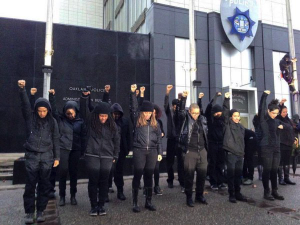
This act of solidarity against the police is profound given the historical tensions between Asians and African Americans in the US, especially in California. For the cross-racial animosity during the 1992 LA uprising, following the non-indictment of the police officers that brutally beat Rodney King, remains a seminal moment of division between the two groups. Media footage of the media-dubbed “riots” showcases African Americans looting and destroying businesses in LA’s Koreatown, with Asian shop owners taking up arms when the L.A.P.D did not respond to their calls for help. TV screens were saturated with images of African Americans breaking shop windows and setting stores ablaze, while Koreans shot their pistols and rifles in self-defense.

Without adequate historical context, news outlets exacerbated longstanding misunderstandings between the two groups. Far from being the result of inherent cross-racial biases or prejudices, the violence between African and Korean Americans during the uprising was rooted in the construction of the “model minority” stereotype, a direct result of immigration policy that created competition between peoples of color.
Nearly 30 years before the uprising, the U.S. opened its borders to East and South Asians after a longstanding population quota against these groups. The 1965 Immigration and Nationality Act let Asians and their families into the United States with the stipulation that these new immigrants had to be educated professionals. They were not from their home country’s working class, nor were they disenfranchised refugees. The aim of the Act was to stimulate the U.S. economy while providing first-world opportunities to these new migrants. Unlike the European immigrants who came before, these new immigrants had financially promising skill sets from the start. As Vijay Prashad points out in his book The Karma of Brown Folk, this new minority class was designed to provide solutions for American issues – racial and economic – not compound its problems. Therefore the Asians of ‘65 were not just a new group of minority immigrants, but would become new and model class of minorities – formally educated, economically independent, well behaved, and family oriented.
That the “model minority” class of immigrants began its construction at the height of the African American struggles for desegregation – the same year of the Civil Rights Voting Act and assassination of Malcolm X – is symbolic of the divisions that were bound to arise between people of color in the United States. One group was given open opportunity and another was struggling for that same opportunity — and interacted in very close quarters. Because of a language barrier, as was the case with new Koreans, many new Asian immigrants in the 1960s, 1970s, 1980s were unable to get jobs in their preferred fields of science and engineering (see the film, Clash of Colors). Instead, they established businesses in what were affordable areas to them, but where many white Americans refused to set up shop – impoverished and predominately African American. However, with little to no knowledge of U.S. race relations, in the words of Prashad in his book Everybody Was Kung Fu Fighting: Afro-Asian Relations and the Myth of Cultural Purity: “they were unaware of the political powder keg they were about to ignite” (155).
African American resistance to these new Asian businesses was strong. Many Koreans worked in black areas, but resided elsewhere. Their language barrier was seen as a refusal to learn the language of the community. As a result, African Americans saw that they did not integrate or support the communities that they served – all while many African Americans were not financially able to own businesses their own communities because of structural poverty. Black New York newspaper The Amsterdam News ran headlines that warned African Americans of “Korean Invasion” and Spike Lee dramatized black and Korean tensions in his 1989 film, Do the Right Thing. In 1990, the Black Nationalist lead “Flatbush Boycott” ran a campaign against Korean shop owners in Brooklyn. On the West Coast, the LA Sentinel ran similarly discriminatory headlines in the late ’80s and in 1991 Ice Cube released the song “Black Korea” in which he rapped a startling premonition: “Every time I wanna go get a fuckin brew/I gotta go down to the store with the two/oriental one-penny countin motherfuckers…So don’t follow me, up an down your market/Or your little chop suey ass’ll be a target/of the nationwide boycott/ Juice with the people, that’s what the boy got/So pay respect to the black fist/or we’ll burn your store, down to a crisp.” Black/Korean tensions on the West Coast came to a head when, just 13 days before the Rodney King beating, 15 year old African American teenager Latasha Harlins was shot and killed by 51 year old Korean shop owner Joon Ja Du who accused the young girl of stealing orange juice. In this context, the violence between Asians and blacks during the 1992 uprising seemed inevitable. However, it is important to remember that the problem between African Americans and Koreans at that time was not solely one of attitude or stereotype but, in Prashad’s words, “a fundamental flaw in the social relations between people” (116). There have been political forces that created these divisions. After all, a “model minority” class of color implies that there was and is a class of color that needs a model to follow.
Black-Asian relations in the 1990s were not all tense, however. Indeed, a recent NPR report found that during the final days of the “riots,” Koreans in L.A. began to make concerted efforts to reconcile with the African American community it served.

With the expansion of the 1965 Immigration Act in 1990, came more opportunity for productive cross-racial and cross-cultural exchange. For example, in The Tao of Wu, Wu Tang Clan member RZA recounts the long afternoons he spent watching Ku Fu Movies at the $2 Asian theatres in New York (47). His time immersed in Asian cinema had a direct impact on his creative aesthetic and spiritual philosophy.

In turn, music producer Sophia Chang recalls that she shied away from her Asian heritage until she signed a Kung Fu loving hip hop tro named Fu-Shnickens and later met Wu Tang. She writes: “I was a second-generation Korean Canadian who lost her language and ate cheeseburgers while the rest of the family feasted on kalbi and banchan. In 1992, my racial and cultural denial was alive and kicking. It wasn’t until I met Wu-Tang that…my belated ‘Asian Renaissance’ started”. Eddie Huang, too, has used hip-hop to help negotiate his place in the United States as a child of Chinese immigrants. His memoir Fresh off the Boat (now a television show) recounts the impact of 1990s hip-hop as he navigated assimilation and oftentimes devastating home life. It is no wonder that he is good friends, now, with Ta-Nehisi Coates. And as early as 1991 director Mira Nair released Mississippi Masala, a film that dramatized a complex love affair between the daughter of African-Indian immigrants who run a liquor store and a young Southern black man with his own carpet cleaning company.


The impact of black culture and thought on Asian-Americans and vice versa cannot be underestimated. As #Asians4BlackLives makes clear, important alliances are imminent. —Rebecca Kumar
 –
R.I.P.? The Rise (and Fall) of Neo-Soul
“Soul music is soul music. It can be wrapped up in a neo soul package; it can be called hip-hop soul. But soul is soul, and it’s been around; it will never go away.”
Maxwell, Gulf News
Samples, mixes, electronic bass, high hats, and Motown-esque harmonics underneath idiosyncratic stories of love, politics, and identity positioned neo-soul as an alternative to the decade’s earlier fascination with West Coast gangsta rap by blending elements from various genres to create a new sound: brass horns and improvisation mimic jazz compositions, stacked harmonies and electric guitar melodies replicate 70s soul and funk, and digital beats and storytelling borrow from 80s hip-hop. In the mid-90s, Neo-soul artists seamlessly fused these elements and combined them with original lyrics, branding the genre as a new approach to old conventions.
The term “neo-soul,” universally credited to former Motown Records president Kedar Massenburg, names a space for borrowing and creating. Neo-Soul’s patriarchal genealogy is unclear; some reference D’Angelo’s commercial success with Brown Sugar as his right to the genre’s throne, but others believe Tony! Toni! Toné! front man Raphael Saadiq initially created the experimental space neo-soul now inhabits. Saadiq (and other late 80s/early 90s R&B artists) began experimenting with R&B’s conventions by addressing topics outside love and relationships and mixing electronic elements with live band compositions. The resulting work provided emerging artists creative license while footing them in established soul, funk, and hip-hop roots.
Erykah Badu, neo-soul’s undisputed matriarch, stepped to the mic declaring that her “cypher keeps moving like a rolling stone.” Merging hip-hop (cypher) and soul (Temptations’ “Papa Was A Rolling Stone”), Badu’s 1997 Baduizm presented the definitive neo-soul archetype for artists to-come. Her lyrical content engages love and happiness, familial relationships, political affiliations, and her status as controller of her universe-In, Baduizm’s “Apple Tree,” the songstress makes her position clear: “The world is mine when I wake up/I don’t need nobody rollin’ over lookin’ after me.”
Later neo-soul artists and enthusiasts certainly owe the music’s success to the innovations of Massenburg, D’Angelo, Saadiq, and Badu. Massenburg’s commodification of the sound through the term “neo-soul” packaged the movement for mass consumption, providing fans an accessible product and clearly delineated identity for entertainers. Saadiq’s experimentation acted as the Beta Test for blending diverse sounds. Together with the first accomplishments, the pioneering artists unification of the look and the sound made neo-soul what it was at its height: an intellectual melodic commentary on social, political, economic, and romantic aspects of black realities in the 90s. The music evolved into a lifestyle centered around collective concern for and protection/support of black lives, with an emphasis on interconnectedness through the recognition of individuals as “brothers” and “sisters.”
Though little debate surrounds neo-soul’s impact on Black culture and music in the 90s, recent discussions about its relevance today question how much, if at all, neo-soul exists as an independent genre capable of influencing music trends and lifestyle behaviors. Many artists, both underground and mainstream, take advantage of social media’s ability to instantaneously reach millions of people and receive raw feedback about their work. Where record labels used to primarily discover new talent and market it to the masses, fans now heavily influence artist popularity. Additionally, digital publication allows artists to control their work’s release and opt to expose their albums/mixtapes/singles without corporate backing. Neo-soul, as a publically commodified sound, shifted towards less emphasis on label support and more concern with producing music the fans wanted to hear, and people still want the raw, vulnerable connection to the artists that first made neo-soul popular.
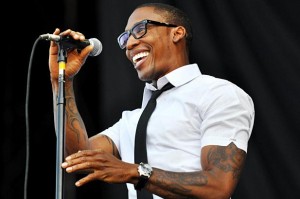
If facts are necessary, the numbers also show that neo-soul remains relevant. Mother Badu boasts an impressive 18-year career, featuring 59 award nominations and 16 wins, 6 albums, 5 number one singles, and a host of features, music videos, and collaborations. Later generations born from the Saadiq-D’Angelo-Badu lineage include artists committed to the self-empowerment and communal love essential to the movement, but they each bring their own flavor to the sound. Those artists include Jill Scott, Musiq Soulchild, Lauryn Hill, Anthony Hamilton, Angie Stone, and India Arie (each who achieved commercial success); others, like Dwele, Ledisi, Leela James, Van Hunt, Tweet, and Bilal embody the neo-soul spirit on a smaller commercial scale.
Music’s evolution creates space for innovations and new artists. And established artists are always pursing new sounds (see Badu’s But U Caint Use My Phone, inspired by Drake’s “Hotline Bling” [which is stolen sampled from D.R.A.M.’s “Cha Cha”]) to grow within the field and with the fans. Neo-Soul’s hybrid composition lends itself to the very sampling, mixing, and collaboration used to create the sound. Because so many sounds begin with techniques popular in other genres, it’s tough to mark a definitive end of any era. —Shari Arnold
The People|The Sound|The Influences|




References:
<http://www.rollingstone.com/music/news/the-soul-and-science-of-erykah-badu-20100415>
<http://www.rollingstone.com/music/news/q-a-erykah-gets-her-gun-20010214>
<https://books.google.com/books?id=yCUEAAAAMBAJ&pg=PA72#v=onepage&q&f=false>
<http://www.rollingstone.com/music/news/the-soul-and-science-of-erykah-badu-20100415>
<https://en.wikipedia.org/wiki/Neo_soul>
<http://gulfnews.com/life-style/celebrity/maxwell-makes-his-comeback-1.1276195>
<http://soultrain.com/2014/11/19/neo-soul-music-still-exist/>
<http://www.stereogum.com/1846378/album-of-the-week-erykah-badu-but-you-caint-use-my-phone/franchises/album-of-the-week/>
The Black Imagination and Possibility: Afrofuturist Aesthetics in the 90s and Beyond
What better cultural and theoretical aesthetic to interrogate the interplay of black cultural life in the 90s, the present, and beyond than Afrofuturism? The term refers to a broad aesthetic form that employs technology and various artistic forms (it combines elements of science fiction, fantasy, history, magical realism, and Afrocentrism) to link a historical African past with an imagined black diasporic future.
Attempts by black artists to explore diasporic identity, to reconcile the past with the present, and subsequently envision a future where black is situated as subject, are not new. However, this phenomenon was dubbed “Afrofuturism” in 1994 when Mark Dery, a cultural critic and early writer on techno culture, examined recurring features and themes in African American science fiction, music, and art. In his essay “Black to the Future,” as part of an anthology called Flame Wars: The Discourse of Cyberculture, Dery interviews writers, such as Samuel R. Delany, Greg Tate, and Tricia Rose, in an attempt to explore concerns raised by African Americans writers in the science fiction genre. In the essay, he writes:
Speculative fiction that treats African American themes and addresses African-American concerns in the context of the twentieth-century counterculture–and, more generally, African-American signification that appropriates images of technology and a prosthetically enhanced future–might, for want of a better term, be called ‘Afrofuturism.’
His coinage and definition of Afrofuturism directly relates to science fiction tropes. However, scholars, like Alondra Nelson, Greg Tate, and Tricia Rose (among many others), note that the term encompasses varied art forms and genres, as they relate to black culture and its African retentions.
Important to note is that Dery merely assigned a name to this aesthetic; the form itself has been practiced in black diasporic art for years. There is general sense that the features that comprise an Afrofuturist aesthetic are embedded in black cultural DNA; for they hark in every way to a diasporic identity. In an interview, Alondra Nelson, a social scientist who writes on intersectionality of science, technology, medicine, and inequality, says of the term that it “captured what we’d always known about black culture, but it gave us something to call it, to name it…It gives us a tradition and a legacy, where all the pieces sort of fit together.”
Dery’s article is comprised of commentary from Delany, Tate, and Rose, and these three construct the framework of what we know to be Afrofuturism today. Earlier than that, however, Mark Sinker and Greg Tate were generating conversations about black science fiction and its connection to techno culture and music, among others. In 1992, Sinker published an essay, “Loving the Alien” in The New Inquiry, in which he equates historical slavery with alien abduction as represented in literature. Tate wrote a review of David Toop’s Rap Attack called “Yo! Hermeneutics!”, which highlights a science fiction sensibility in black music. According to Nelson, Afrofuturist art, no matter the medium, is imbued with futuristic themes and capitalizes off technological innovation. In the fall of 1998, then a graduate student at NYU, Alondra Nelson and artist Paul D. Miller established an on-line Afrofuturism listserv, and launched Afrofuturism.net in 2000. Both sites were dedicated to science fictions and discussed how the genre addresses a “past of abduction, displacement and alien-nation” and inspires “technical and creative innovations.” Also, in September of 1999, Nelson organized an Afrofuturism forum at NYU, which dedicated conversation to the “future of black production.”
There is no singular definition of Afrofuturism; the aesthetic is as varied and fluid as the cultural identities it explores. To this day, the aesthetic comprises an array of media forms, including, but not limited to, textual, visual, and aural arts. However, at the heart of this aesthetic form lie some artistic and cultural product that 1. examines the past, 2. critiques the present, and 3. “imagines possible futures.” Many works by Afrofuturist artists, in some way, blend elements of the past with the future to assert opinions on sociopolitical and cultural issues concerning black people. With regards to literature, these opinions usually manifest in the dystopian genre. For example, Octavia Butler’s “The Parable Series” (1993-1998), interrogates notions of racial and gender identity in the 2020s. Her depiction of a futuristic society, depraved and plagued by an exacting, ever-widening gap between the rich and poor easily resembles a not-so-far-distant past, and perhaps even the present. Butler, among other black sci-fi writers, also often re articulated traditional African religion and customs in the futuristic contexts of her novels.
Undoubtedly, an Afrofuturistic aesthetic pervades black culture in the 90s. Primarily the music is informed by futuristic sensibilities. Scholars, like Tricia Rose, pointed out how this manifested in the form of technology and sound reproduction. In an interview with Mark Dery, she says, “Digital music technology—samplers, sequencers, drum machines— are themselves cultural objects, and as such the carry cultural ideas.” Musicians, while utilizing aural mechanisms to revamp sound, also incorporated Afrofuturist themes in a visual and lyrical context. Outkast, for example, definitely falls within this extensive lineage of Afrofuturist artists with the albums ATLiens (1996) and Aquemini (1998). Both albums pushed the bounds of production with extraterrestrial sounds and existential, imaginative lyrics.


Afrofuturist elements can even be found in Erykah Badu’s video for “Didn’t Cha Know” as it alludes to a liminal space where the subject wanders, simultaneously reaching into the past (allusions to Africa, Kimetics, and Egyptology) and looking towards an uncertain, yet hopeful future. This musical lineage extends even further back, however, to artists, such as George Clinton and Sun Ra, and groups like PFunk, who melded their historically informed visions of the future with jazz and funk sounds. More discussion on the emergence of Afrofuturist aesthetics in science fiction and popular music pre-1990s and 21st-century can be found in John Akomfrah’s 1996 documentary “Last Angel of History.”
Undoubtedly, Afrofuturist themes pervade most areas of black culture today, perhaps more so than it ever has. Its prevalence is evident from the music of Janelle Monae and Flying Lotus, to the novels of Nnedi Okorafo and Tananarive Due, to the visual and performing arts of Adejoke Tugbiyele and OluShola A. Cole. That its popularity is growing makes sense, since we are still ironing out methods of reclaiming culture, reinventing tradition, and redefining notions of blackness. The questions posed and pondered, even before the advent of Afrofuturism as a theoretical perspective, still remain: How do black people imagine a better future for black people? What does that future look like? And, how do we get there? —Keith Freeman
_____________________________________________
Works Cited
Dery, Mark. “Black to the Future: Interviews with Samuel R. Delany, Greg Tate, And Tricia Rose.” Flame Wars: The Discourse of Cyberculture . Durham, NC: Duke University Press, 1994. 179-222. Print.
Nelson, Alondra. “Introduction: Future Texts.” Social Text. 20.2 (2002): 1-15. Web. 10 November 2015.
Soho Rep. “Afrofuturism.” Online video clip. YouTube. Youtube, 22 Apr. 2006. Web. 05 November 2015.
Representations of Black Gay Men in “Paris is Burning” & “Tongues Untied”
Both “Paris is Burning” (1990), a documentary film by Jennie Livingston, and “Tongues Untied” (1989), a semi-autobiographical docufilm by Marlon Riggs explore the communities of transgender and gay people of color and its members’ efforts to reconcile racial and sexual identities.

Both films are groundbreaking in their portrayal of the difficulty of exploring various identities while living under the scrutiny of white, patriarchal society. Via the pageantry and pomp of the drag and ballroom scene in New York in the 80s and 90s, “Paris is Burning” explores gay Black, Latino, and transgender communities, as its members confront issues of race, gender, and sexuality. In interviews, often melancholic, the documentary participants (i.e. Pepper Labeija, Dorian Corey, & Angie Xtravaganza) often profoundly muse on lives plagued by familial, romantic, and societal rejection based on their sexuality.
Each speaks candidly about homelessness and ostracization, and how ballroom scenes offered places of refuge, kinship, and security. They too admit how
such arenas allowed them to escape realities and act out desires to attain a more affluent, Eurocentric standard of living. “Paris is Burning” has been legitimately critiqued for being more exploitative than politically challenging. Albeit a valid point, the film retains some cultural value.
“Tongues Untied” melds 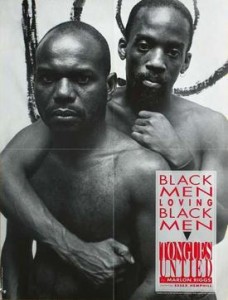 narrative accounts via its director, Marlon Riggs, with fictional vignettes and interpretive poetry that represent a collective yet varied and mutable black, gay identity. The docufilm focuses primarily on gay black men (e.g. Essex Hemphill, Joseph Beam, Craig Harris and Riggs himself) , who also openly and unapologetically confront the ugly heads of racism and homophobia. Scenes of clips from homophobic stand up routines (e.g. by Eddie Murphy) and of the Civil Rights Movements serve to combat negative stereotypes and link the struggles of black, gay men with an historical legacy of resistance. Undoubtedly, “Tongues Untied” is focused and political in its thrust, arguably more so than “Paris is Burning.” Unlike Livingston, Riggs chooses not only to depict men stymied under the weight of white supremacy, but also takes the system to task, illustrating instances of fierce opposition. One such oppositional method is the refutation of silence preluded by the film’s title. Riggs directly challenges this inclination towards silence, not in a way that begets shame (he focuses his critique on a society that promotes and demands speechlessness), but rather one that privileges the power of black, gay men’s voices. Undoubtedly, herein lies the revolutionary mark of “Tongues Untied.”
Many comparisons have and continue to be drawn between the two films, with respect to representation of gay and transgender communities. bell hooks’ commentaries on the “gaze” and “subjectivity” are good entry points to discuss this issue. Interestingly, hooks discusses “Paris is Burning” in her book Black Looks: Race and Representation. She writes,
“(…) Jennie Livingston approaches her subject matter as an outsider looking in. Since her presence as a white/lesbian filmmaker is “absent” from Paris Is Burning, it is easy for viewers to imagine that they are watching an ethnographic film documenting the life of black gay “natives” and not recognize that they are watching a work shaped and formed by a standpoint and perspective specific to Livingston.”
Livingston, albeit a lesbian woman, operates from a place of privilege as a white woman. And, her racial and social status, though it should not discredit her or deem her incapable of exploring a culture outside her own, should call into question intent and the adequacy of her representation. Yes, Livingston sought to give voice to a particular community. However, her method becomes problematic considering it does not allow “subjects” to negotiate the terms of their own representation. They speak on their experiences and struggles, joys and pains, yes. However, they relinquish substantial ownership over the telling of their stories. Thus, they do not even retain any centrality in the work as it were. That these men and trans women fell back into relative obscurity post-film further elucidates the reality of their marginalization.
On the other hand, Riggs intentionally positions black, gay men centrally in “Tongues Untied.” Worthy of consideration is the holistic picture presented by Riggs and his cohort. Inherent in the film is a clear beginning, a journey that ebbs-and-flows, and an ending that is not altogether complete, but unmistakably hopeful. In the end, Riggs, having reflected on intense pain and internal conflict, remarks, “Whatever awaits me, this much I know: I was blind to my brother’s beauty, and now I see my own.” Unlike “Tongues Untied”, “Paris is Burning” is more fragmented, and the totality of experiences of gay men of color goes unaddressed. That TU is both created for and composed by black men undergirds and reaffirms its closing remark, “Black men loving black men is the revolutionary act.” —Keith Freeman
_______________________________________
Works Cited
hooks, bell. “Is Paris Burning?” Black Looks: Race and Representation. New York, NY: South End Press, 1992. 145-156. Print.
Paris is Burning. Dir. Jennie Livingston, 1990. Film.
Tongues Untied. Dir. Marlon Riggs, 1989. Film.
Pass the Blunt

“WHAT?!! Pass the Blunt?”….Soooo why do you smoke cause I don’t…don’t get it?
-June 17, 1999 at 6:25pm-
Now what I am about to say may cause some people to form a certain view about me and maybe not respect my opinion…but please note that this is only my opinion! I just do not get the concept of smoking weed. I have heard others say that it’s for enjoyment purposes only…and I have heard other weed heads say, that it’s a need. I personally think that it is a mechanism that can be used to keep the “have nots” to stay in their lower economic class and not to progress.
Through my educational endeavors, I have discovered that “others” view African Americans, as well as Hispanics, as inferior by falling victim to certain “unseen mechanisms”. I feel that weed is a part of these forces and are placed in individuals hands to keep them grounded. Now come on, what drug has the same damaging effects that weed has? I mean it can stop you from climbing the economic ladder. “Weed heads” usually use the concept that “it’s just like any other substance like alcohol and cigarettes”…but those are ALL legal.
My brothers and sistahs are so quick to speak about smoking “dro” or “ching chong” in music videos and in the street, but they will turn around and wonder why they are not getting hired. Others use the drug as a sedative for when they get stressed or find themselves under extreme amounts of pressure, but to these individuals I ask…are there any other “legal” avenues of expression and or relief that can be utilized that would not cause you to loose your livelihood?
This is only my opinion for I welcome yours.
-My thoughts today in 2015!-
As I look back to where I was 6 years ago mentally, I must say that I am amazed at what I wrote. Though I shared some of the same sentiments that I expressed above, I will say that acquired age, academic pursuits and experience has elevated my thinking on the topic. I have dated someone who was indeed a weed head, they lived to be high. That experience caused me to write the previous piece, thus causing me to feel like people only did the drug for recreation purposes, but love made me take an alternative view on the topic. After an argument, my partner disclosed that, the only reason they smoke was more than for recreational purposes; but for relief of from chronic headaches. Living in the days of unconventional modes of medicine, weed is now seen as an oasis in the storm: an avenue of relief for pain. It’s easy for people to judge accused weedheads and thugs based upon a “rough” exterior. But what if they had an illness that only weed could cure. The 1990s brought the use of weed to the forefront, the present has brought weed into the avenue of conventional medicine. Weed may not be so bad after all, but it damn sure is still not for me!!
