Representations of Black Gay Men in “Paris is Burning” & “Tongues Untied”

Both “Paris is Burning” (1990), a documentary film by Jennie Livingston, and “Tongues Untied” (1989), a semi-autobiographical docufilm by Marlon Riggs explore the communities of transgender and gay people of color and its members’ efforts to reconcile racial and sexual identities.

paris_is_burning

Both films are groundbreaking in their portrayal of the difficulty of exploring various identities while living under the scrutiny of white, patriarchal society. Via the pageantry and pomp of the drag and ballroom scene in New York in the 80s and 90s, “Paris is Burning” explores gay Black, Latino, and transgender communities, as its members confront issues of race, gender, and sexuality. In interviews, often melancholic, the documentary participants (i.e. Pepper Labeija, Dorian Corey, & Angie Xtravaganza) often profoundly muse on lives plagued by familial, romantic, and societal rejection based on their sexuality.

Each speaks candidly about homelessness and ostracization, and how ballroom scenes offered places of refuge, kinship, and security. They too admit how
such arenas allowed them to escape realities and act out desires to attain a more affluent, Eurocentric standard of living. “Paris is Burning” has been legitimately critiqued for being more exploitative than politically challenging. Albeit a valid point, the film retains some cultural value.

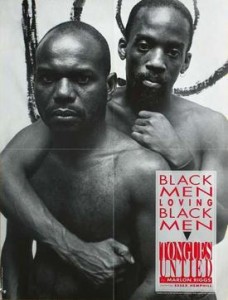
“Tongues Untied” melds Tongues-untiednarrative accounts via its director, Marlon Riggs, with fictional vignettes and interpretive poetry that represent a collective yet varied and mutable black, gay identity. The docufilm focuses primarily on gay black men (e.g. Essex Hemphill, Joseph Beam, Craig Harris and Riggs himself) , who also openly and unapologetically confront the ugly heads of racism and homophobia. Scenes of clips from homophobic stand up routines (e.g. by Eddie Murphy) and of the Civil Rights Movements serve to combat negative stereotypes and link the struggles of black, gay men with an historical legacy of resistance. Undoubtedly, “Tongues Untied” is focused and political in its thrust, arguably more so than “Paris is Burning.” Unlike Livingston, Riggs chooses not only to depict men stymied under the weight of white supremacy, but also takes the system to task, illustrating instances of fierce opposition. One such oppositional method is the refutation of silence preluded by the film’s title. Riggs directly challenges this inclination towards silence, not in a way that begets shame (he focuses his critique on a society that promotes and demands speechlessness), but rather one that privileges the power of black, gay men’s voices. Undoubtedly, herein lies the revolutionary mark of “Tongues Untied.”
Many comparisons have and continue to be drawn between the two films, with respect to representation of gay and transgender communities. bell hooks’ commentaries on the “gaze” and “subjectivity” are good entry points to discuss this issue. Interestingly, hooks discusses “Paris is Burning” in her book Black Looks: Race and Representation. She writes,

“(…) Jennie Livingston approaches her subject matter as an outsider looking in. Since her presence as a white/lesbian filmmaker is “absent” from Paris Is Burning, it is easy for viewers to imagine that they are watching an ethnographic film documenting the life of black gay “natives” and not recognize that they are watching a work shaped and formed by a standpoint and perspective specific to Livingston.”

Livingston, albeit a lesbian woman, operates from a place of privilege as a white woman. And, her racial and social status, though it should not discredit her or deem her incapable of exploring a culture outside her own, should call into question intent and the adequacy of her representation. Yes, Livingston sought to give voice to a particular community. However, her method becomes problematic considering it does not allow “subjects” to negotiate the terms of their own representation. They speak on their experiences and struggles, joys and pains, yes. However, they relinquish substantial ownership over the telling of their stories. Thus, they do not even retain any centrality in the work as it were. That these men and trans women fell back into relative obscurity post-film further elucidates the reality of their marginalization.

On the other hand, Riggs intentionally positions black, gay men centrally in “Tongues Untied.” Worthy of consideration is the holistic picture presented by Riggs and his cohort. Inherent in the film is a clear beginning, a journey that ebbs-and-flows, and an ending that is not altogether complete, but unmistakably hopeful. In the end, Riggs, having reflected on intense pain and internal conflict, remarks, “Whatever awaits me, this much I know: I was blind to my brother’s beauty, and now I see my own.” Unlike “Tongues Untied”, “Paris is Burning” is more fragmented, and the totality of experiences of gay men of color goes unaddressed. That TU is both created for and composed by black men undergirds and reaffirms its closing remark, “Black men loving black men is the revolutionary act.” —Keith Freeman

_______________________________________

Works Cited

hooks, bell. “Is Paris Burning?” Black Looks: Race and Representation. New York, NY: South End Press, 1992. 145-156. Print.

Paris is Burning. Dir. Jennie Livingston, 1990. Film.

 Tongues Untied. Dir. Marlon Riggs, 1989. Film.

McMillan and Harris: The Mother and Father of Black Fiction

Terry McMillan came on the literary scene in 1987 with her first novel Mama, however it was not until she published her third novel Waiting to Exhale in 1992 that she received fame and fortune. Waiting to Exhale told the story of four professional, middle class black women and their experiences with love. Readers experienced each character’s loneliness, destruction, happiness, sadness, sexual desires, and frustrations with black men; things that readers, especially female readers, could relate to.

While some argued the novel represented a negative view of the black woman and her relationship with black men, the novel spent months on the New York Times Bestseller list and went on to sell over three million copies, and a film adaptation was released in 1995 that featured Whitney Houston. Author and professor Daphe A. Brooks says of the novel: It marked a watershed moment in American culture as it announced and contributed to a shift in Black popular cultural consciousness and production during the last decade of the twentieth century. Advantageously positioned in the aftermath of the Clarence Thomas/Anita Hill Senate hearings, Exhale dramatically extended and popularized for mass consumption the politics of a particular kind of heterosexual, Black middle-class conflict and desire.[i]

McMillan’s novel Waiting to Exhale not only depicted a demographic, middle-class black women, of people not regularly seen in literature, but she also shed light on the complexities of relationships.

McMillan is credited for jumpstarting the African American fiction movement with Waiting to Exhale, and throughout the decade she went on to write more novels that gave glimpses of black love and published one of her most popular novels How Stella Got Her Groove Back in 1996; in 1998, the film adaptation featuring Angela Bassett and Taye Diggs was released. The novel told the story of Stella and her relationship with Winston, a man considerably younger than her. Winston taught Stella to embrace life and eventually his love because she married him. The novel mirrored McMillan’s experience with then husband, Jonathan Plummer.

How Stella Got Her Groove Back is another novel that sets McMillan apart because she reveals the questions, concerns, hopes, and fears of dating someone younger. Stella (and McMillan) has to deal with the thrills and drama that comes along with dating someone younger and at a different stage in life. Likewise, Terry McMillan’s novels did not only deal with love in terms of black men and black women, a few of her works also introduced black’s complex relationship with homosexuals. She weaves in political and social concerns in the black community, such as the understanding (or misunderstanding) of HIV/AIDS and the negative stigma of being black and gay.

Consequently it is of no surprise that another author would emerge and hit the issue of being black and gay head on instead of touching on the subject as McMillan does. Author E. Lynn Harris filled this role and shocked the world with his tales of black men on the DL and carrying on relationships with women. Harris’ novel Invisible Life (1991) told the story of Raymond Tyler struggling with his identity as a bisexual black man. In the novel, Tyler was torn between his married boyfriend and girlfriend. Although readers were stunned by the then-taboo topic, the novel went on to sell millions of copies. Harris’ novels speak to an audience that was largely ignored by authors. All of his books reached the New York Times bestseller list and he is one of the most successful black authors. He was even referred to as the male Terry McMillan.

Some were surprised by Harris’ success because the black community does not readily accept or discuss homosexuality. In an interview with Publisher’s Weekly, Harris says, “I feel like my readers get that I’m writing from the heart, and that resonates with a lot of people in the black community, women especially. Even though the character might be a gay man, they can connect with him emotionally. They can relate to being in hurtful relationships, and because they get that, it doesn’t matter if it’s a gay or a straight relationship” (2003). [ii] Even though homosexuality in the 90s was a taboo subject, readers could relate to Harris’ works. He spoke for and told stories for those who could not speak for themselves during that time.

Both authors captured readers by representing and telling stories that black women and men craved, and they provided literature for black middle-class Americans, a largely underrepresented group before the 90s. McMillan and Harris used personal experiences and turned them into fiction in order to reach and possibly help a multitude of people. Without their persistence in creating stories that people could relate to, who knows what black fiction would look like now. —B. Stewart


[i] Brooks, Daphe A. “”It’s Not Right But It’s Okay”” Taylor & Francis Online. Souls: A Critical Journal of Black Politics, Culture, and Society. 2 Feb. 2011. Web. 16 Nov. 2015.

[ii] Millard, Elizabeth. “Writing to Find Some Kind of Peace of Mind.” PublishersWeekly.com. N.p., 16 June 2003. Web. 21 Nov. 2015.


Freaknik: The Black College Spring Break

“Mention Freaknik to any native Atlantan and you’re in for an earful — while the celebrations ended years ago, the memories are still fresh in many peoples’ minds,” wrote Michael Kahn.[i] Freaknik began in the mid 80s as a small picnic between Morris Brown and Spelman students, yet really gained traction and popularity during the early to mid-90s and became an important staple in the black college spring break experience. An impromptu gathering birthed a street party that attracted HBCU students across the country and by 1993, Atlanta’s streets were packed with students looking to party and as the name suggests, get their freak on. The music was loud, the clothes were tight, the drinks were flowing, and the streets were crowded. When stripped down to these terms Freaknik represented a time for black students to get together and just chill.

Atlanta has a history of breeding and nurturing black American culture and Freaknik was no exception. Freaknik of 1993 took the city by surprise when at least 100,000 college students stormed Atlanta, making it a party zone. What made Freaknik of 1993 incredible was the power of word of mouth. No one tweeted, IGd, Facebooked, or Snapchatted the event, it just happened. Students at HBCUs across the country heard about Freaknik some way or another and had to be in Atlanta, not at a beach, but on the streets of Atlanta.

The location and time: The third week of April, Piedmont Park in Atlanta, Peachtree street spanning into the West End of Atlanta (near the AUC Center), Auburn Avenue, and other streets of Atlanta hosted the event. The early days, people spent time in Piedmont Park socializing and having a good time, and as Freaknik evolved and grew in popularity, people spent time bumping music while gridlocked in traffic and eventually at clubs and concerts catered to the event. Clubs such as 559, The Gate, and Club 221 featured artists like Uncle Luke, Killer Mike, Jermaine Dupri, and Snoop Dogg and boasted large parties.

By 1994, Atlanta hosted nearly half a million Freaknik attendees, and the increased popularity brought the city of Atlanta millions of dollars in revenue. However, the growing popularity also brought greater risk of violence. College students were left to their own devices without much interference from the city and over the years more cases of rape and assault were reported. Mayor Kasim Reed said of the event, “I think that Freaknik was a good thing—until it wasn’t, until it lost its essence. It stopped being about black students having a good time and took on an All-Star Game type of feel. It really became a black Daytona Beach.”[ii]

As Atlanta prepared for the 1996 Olympics there was a push to “clean up” and rename Freaknik (i.e. Spring Jam 1997). Yet, the renaming didn’t hold. Eventually, an increased police presence and crackdown on lewd behavior and partying led to Freaknik fizzling out by 1999. Students traveled to beaches such as Daytona instead. It was the end of an era. At the end of the day, Freaknik was a historic event that gave black college students a chance to get together and simply hang out; and although it didn’t last very long, Freaknik introduced Southern rappers to the world and paved the way for music videos that featured scantily clad women that accentuated their assets and public twerking became the norm.[iii] Just think: what would music videos look like today if it weren’t for Freaknik? Would twerking be as popular? Thanks to this “freaky” event, we will never know. ––B. Stewart


[i] Kahn, Michael. “Freaknik Memories.” Curbed Atlanta. N.p., 20 Mar. 2015. Web. 15 Nov. 2015.

[ii] “Freaknik: Rise and Fall of Atlanta’s Most Infamous Street Party.” Atlanta Magazine. N.p., 17 Mar. 2015. Web. 15 Nov. 2015.

[iii] Elliott, Angel. “The Oral History of Freaknik.” Complex. Complex Media, Inc, 12 Apr. 2013. Web. 15 Nov. 2015.


Do your pants hang low?

Sagging pants

So it is my first day of 7th grade (1997) and I am trying to figure out the best “fit” to wear. In the hopes of being cool, I decided that my “code” (dress code) needed to be different than it was the previous year. This year, I have decided to sagg like the rest of my male counterparts. I look through my closet and ensure that the jeans that I pick, will be just as big and as baggy in order to ensure they sagg just right. I accompany my jeans with my polo shirt, and timbs (timberlands), and proceeded out the door. Right before my foot hit the pavement, my grandmother yells “bring yo red ass back into dis house and pull up dem damn pants. No Grandson of mine is going to be owt there in da streets lookin like a fool wit does damn paints down under their ass”. Just to appease her, I rushed back into my room and temporarily pull up and restrain my paints with a belt. With my freedom being obtained through compliance, I escape her grasp and make my way to the bus stop. Before I hit the corner, I quickly adjust my “altered” appearance to its original stance and proceeded on my way. Things were going good and I finally felt “accepted” by my male counterparts and then…..it happened…someone ruined my moment by coming behind me and pulling my pants down to the ground and thus exposed my boxers. When I turned around to “check” whom had did it, I discovered that it was indeed my mother, cussing me out for having my pants so low. “If you wanted to show yo ass, then you shouldn’t mine me pulling them down all the way so that they can see everything”. Though this was the most embarrassing day of my life, it made me not want to ever sagg again because of the fear that my mother may be close by.

When I was a little order, I learned that the phenomenon was once a unspoken signal that denotes sexual availability by inmates in prison, but has been converted into an urban fashion statement. The 90s enlisted the perception that doing it promotes a statement of “hoodness” and the more fly you sag, the “more bitches” you get supposedly. African American youth have once again adopted something else that started out so negative and ushered it into popular urban culture. Youth try so hard to emulate the famous, while the famous try to emulate their muse. In the African American Community, rappers try to emulate thugs. Thugs are housed in the jails and therefore, sagging has and will continue to thrive.

css.php